Polypropylene (PP)
| ABNSABNS — Acid-Based No-Rinse Sanitiser The class of acid-based sanitisers used in homebrewing, combining phosphoric acid with an anionic alkylbenzenesulfonate surfactant. The acid creates a low-pH environment hostile to microorganisms; the surfactant disrupts cell membranes. Examples: Star San, Sanipro Rinse, StellarSan, Chemsan. Approved for use on food-contact surfaces without rinsing when used at the manufacturer's specified dilution. | DESDES — Disinfectant Ethanol Sanitiser ChemiPro DES. An ethanol-based (70–80%) sanitiser with no non-volatile residue. Evaporates completely, leaving no WDC risk. A-rated for all common homebrewing materials. | Cleaning | Beer/wortWort Liquid extracted from malted grain during mashing and boiling, before fermentation. The starting point for beer. | |
|---|---|---|---|---|
| Rating | A | A | A | A |
The Cleaning column aggregates all cleaning product categories used in homebrewing at working concentrations. For a breakdown by cleaner type — alkaline percarbonate, phosphate-based, and oxidising — see the Cleaning compatibility section below.
Polypropylene is one of the most common plastics in homebrewing. The body and lid of most plastic homebrew fermenters are PPPP — Polypropylene A semi-crystalline polyolefin plastic widely used in fermenter buckets, lids, taps, and airlocks. Excellent chemical resistance across all homebrewing chemical environments. EU Regulation 10/2011 compliant., as are the vast majority of plastic fermenter taps. The KegLand 3-piece airlock (KL01595), for example, is confirmed PPPP — Polypropylene A semi-crystalline polyolefin plastic widely used in fermenter buckets, lids, taps, and airlocks. Excellent chemical resistance across all homebrewing chemical environments. EU Regulation 10/2011 compliant. and is specifically recommended as the airlock of choice in this guide for that reason. Purpose-designed PPPP — Polypropylene A semi-crystalline polyolefin plastic widely used in fermenter buckets, lids, taps, and airlocks. Excellent chemical resistance across all homebrewing chemical environments. EU Regulation 10/2011 compliant. fermenter buckets — sold with an airlock grommet and often a tap hole, ready for brewing use — are the most common entry point into homebrewing. The Bryggbolaget 15 L fermenter bucket is a typical example: a low-cost PPPP — Polypropylene A semi-crystalline polyolefin plastic widely used in fermenter buckets, lids, taps, and airlocks. Excellent chemical resistance across all homebrewing chemical environments. EU Regulation 10/2011 compliant. bucket sold by most homebrewing retailers, grommet-fitted, and reached for by beginners and experienced brewers alike. Plain general-purpose PPPP — Polypropylene A semi-crystalline polyolefin plastic widely used in fermenter buckets, lids, taps, and airlocks. Excellent chemical resistance across all homebrewing chemical environments. EU Regulation 10/2011 compliant. buckets from catering and storage supply chains are also used, typically fitted with a grommet and tap by the brewer. Beyond fermenters, PPPP — Polypropylene A semi-crystalline polyolefin plastic widely used in fermenter buckets, lids, taps, and airlocks. Excellent chemical resistance across all homebrewing chemical environments. EU Regulation 10/2011 compliant. appears in bottle washers, funnels, measuring jugs, spray bottle bodies, and a wide range of accessories.
PPPP — Polypropylene A semi-crystalline polyolefin plastic widely used in fermenter buckets, lids, taps, and airlocks. Excellent chemical resistance across all homebrewing chemical environments. EU Regulation 10/2011 compliant. is a semi-crystalline polyolefinPolyolefin A class of polymers made by polymerising simple alkene (olefin) monomers — propylene for polypropylene, ethylene for polyethylene. The resulting polymer has an all-carbon backbone with no functional groups susceptible to hydrolysis, which is the primary reason polyolefins have excellent resistance to acids, alkalis, and aqueous environments. PP and HDPE are both polyolefins.: an all-carbon backbone polymer with no functional groups susceptible to hydrolysisHydrolysis The chemical reaction in which a molecule is split by water, typically at a bond that connects two parts of the molecule. In food contact materials, hydrolysis is the primary mechanism by which acid or alkaline cleaning solutions attack susceptible polymers — particularly those with ester linkages (PET, Tritan, PC) or ether linkages (POM). Polymers with all-carbon backbones (PP, HDPE, PTFE) have no hydrolysable bonds and are inherently resistant to aqueous chemical attack., making it chemically stable across a wide range of aqueous environments. Two grades appear in homebrewing: homopolymer PPPP — Polypropylene A semi-crystalline polyolefin plastic widely used in fermenter buckets, lids, taps, and airlocks. Excellent chemical resistance across all homebrewing chemical environments. EU Regulation 10/2011 compliant. (standard, slightly stiffer) in most bucket bodies and lids, and copolymer PPPP — Polypropylene A semi-crystalline polyolefin plastic widely used in fermenter buckets, lids, taps, and airlocks. Excellent chemical resistance across all homebrewing chemical environments. EU Regulation 10/2011 compliant. (CO-PPPP — Polypropylene A semi-crystalline polyolefin plastic widely used in fermenter buckets, lids, taps, and airlocks. Excellent chemical resistance across all homebrewing chemical environments. EU Regulation 10/2011 compliant.) in some taps, barbed fittings, and other accessories, which has better low-temperature impact resistance. For chemical compatibility purposes the two grades are treated identically throughout this page.
Identifying PP
Look for the Resin Identification Code (RICRIC — Resin Identification Code A numerical code moulded into the base of plastic articles to identify the polymer type, introduced by the Society of the Plastics Industry (now PLASTICS) in 1988 and represented by three chasing arrows forming a triangle with the number inside. Codes 1–7 cover the most common polymer families: 1 = PET, 2 = HDPE, 3 = PVC, 4 = LDPE, 5 = PP, 6 = PS, 7 = other. The RIC identifies the polymer backbone only — it says nothing about the additive package, food grade status, or GMP compliance. Food grade and industrial grade articles of the same polymer carry the same RIC code.) moulded into the base of the article — three chasing arrows forming a triangle, with the number 5 inside and PPPP — Polypropylene A semi-crystalline polyolefin plastic widely used in fermenter buckets, lids, taps, and airlocks. Excellent chemical resistance across all homebrewing chemical environments. EU Regulation 10/2011 compliant. below.
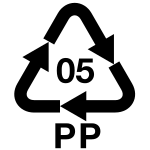
The RIC 5 symbol as it appears on the base of PP articles.
RICRIC — Resin Identification Code A numerical code moulded into the base of plastic articles to identify the polymer type, introduced by the Society of the Plastics Industry (now PLASTICS) in 1988 and represented by three chasing arrows forming a triangle with the number inside. Codes 1–7 cover the most common polymer families: 1 = PET, 2 = HDPE, 3 = PVC, 4 = LDPE, 5 = PP, 6 = PS, 7 = other. The RIC identifies the polymer backbone only — it says nothing about the additive package, food grade status, or GMP compliance. Food grade and industrial grade articles of the same polymer carry the same RIC code. symbol: Anton Poliakov, Wikimedia Commons, CC BY-SA 4.0. Modified: fill colour adapted for dark-mode display.
PPPP — Polypropylene A semi-crystalline polyolefin plastic widely used in fermenter buckets, lids, taps, and airlocks. Excellent chemical resistance across all homebrewing chemical environments. EU Regulation 10/2011 compliant. marking on articles is not legally required by EU regulation — the RICRIC — Resin Identification Code A numerical code moulded into the base of plastic articles to identify the polymer type, introduced by the Society of the Plastics Industry (now PLASTICS) in 1988 and represented by three chasing arrows forming a triangle with the number inside. Codes 1–7 cover the most common polymer families: 1 = PET, 2 = HDPE, 3 = PVC, 4 = LDPE, 5 = PP, 6 = PS, 7 = other. The RIC identifies the polymer backbone only — it says nothing about the additive package, food grade status, or GMP compliance. Food grade and industrial grade articles of the same polymer carry the same RIC code. system is voluntary. Many PPPP — Polypropylene A semi-crystalline polyolefin plastic widely used in fermenter buckets, lids, taps, and airlocks. Excellent chemical resistance across all homebrewing chemical environments. EU Regulation 10/2011 compliant. articles carry it; many do not. The KegLand KL01595 airlock, for example, carries no resin code marking on the article itself; its PPPP — Polypropylene A semi-crystalline polyolefin plastic widely used in fermenter buckets, lids, taps, and airlocks. Excellent chemical resistance across all homebrewing chemical environments. EU Regulation 10/2011 compliant. identification comes from the product name and KegLand's product documentation. In the absence of a code, white or natural-translucent rigid plastic articles in fermenter contexts — bucket bodies, lids, taps — are PPPP — Polypropylene A semi-crystalline polyolefin plastic widely used in fermenter buckets, lids, taps, and airlocks. Excellent chemical resistance across all homebrewing chemical environments. EU Regulation 10/2011 compliant. with high confidence.
Images showing the typical appearance of PPPP — Polypropylene A semi-crystalline polyolefin plastic widely used in fermenter buckets, lids, taps, and airlocks. Excellent chemical resistance across all homebrewing chemical environments. EU Regulation 10/2011 compliant. equipment — bucket body and lid, tap body, KL01595 airlock — and the visual contrast between PPPP — Polypropylene A semi-crystalline polyolefin plastic widely used in fermenter buckets, lids, taps, and airlocks. Excellent chemical resistance across all homebrewing chemical environments. EU Regulation 10/2011 compliant.'s white or translucent appearance and the clear appearance of other plastics such as PETPET — Polyethylene terephthalate The plastic used in the FermZilla All Rounder, Oxebar mini keg, and PET bottles. Recycling code ♻️1. Extensively tested for food contact with carbonated beverages. Do not exceed 40 °C when cleaning., are planned for this section. The same approach — showing what to look for and the basis for confidence in the identification — will be used for other materials including elastomers.
Food grade status
PPPP — Polypropylene A semi-crystalline polyolefin plastic widely used in fermenter buckets, lids, taps, and airlocks. Excellent chemical resistance across all homebrewing chemical environments. EU Regulation 10/2011 compliant. is one of the most extensively approved food contact plastics in the world, listed in EU Regulation 10/2011 with a specific migration limitSML — Specific Migration Limit The maximum permitted amount of a substance that may migrate from a food contact material into food or a food simulant, set by EU Regulation 10/2011. Expressed in mg/kg of food. for its monomer (propylene, SMLSML — Specific Migration Limit The maximum permitted amount of a substance that may migrate from a food contact material into food or a food simulant, set by EU Regulation 10/2011. Expressed in mg/kg of food. 5 mg/kg) and for common additives. Food grade PPPP — Polypropylene A semi-crystalline polyolefin plastic widely used in fermenter buckets, lids, taps, and airlocks. Excellent chemical resistance across all homebrewing chemical environments. EU Regulation 10/2011 compliant. buckets are widely available and are the default for homebrewing use. The full food contact compliance framework — what makes an article food grade, GMPGMP — Good Manufacturing Practice A set of regulated manufacturing requirements under EU Regulation 2023/2006 that food contact material producers must comply with. GMP covers controlled production environments, quality management systems, and traceability — ensuring that a food-approved resin is also processed in conditions that prevent contamination from non-food substances. A material can use an approved additive package and still fail GMP requirements if it is produced in a facility that also processes industrial compounds without adequate separation. requirements, EU simulant testing, DoCDoC — Declaration of Conformity A manufacturer's written statement that a food contact material or article complies with the applicable EU regulations (primarily 1935/2004 and 10/2011). Required at each stage of the commercial supply chain, but not legally required to be provided to end consumers at retail. structure, repeated-use provisions, and what to do without a DoCDoC — Declaration of Conformity A manufacturer's written statement that a food contact material or article complies with the applicable EU regulations (primarily 1935/2004 and 10/2011). Required at each stage of the commercial supply chain, but not legally required to be provided to end consumers at retail. — is covered on the Food contact compliance page. This section covers only what is specific to PPPP — Polypropylene A semi-crystalline polyolefin plastic widely used in fermenter buckets, lids, taps, and airlocks. Excellent chemical resistance across all homebrewing chemical environments. EU Regulation 10/2011 compliant..
What makes a PP article food grade?
The propylene polymer itself is not the concern — the backbone is chemically identical in food grade and industrial grade PPPP — Polypropylene A semi-crystalline polyolefin plastic widely used in fermenter buckets, lids, taps, and airlocks. Excellent chemical resistance across all homebrewing chemical environments. EU Regulation 10/2011 compliant.. The difference lies in the additive package: antioxidants (hindered phenols, phosphite types), nucleating agents, slip agents (typically fatty acid amides), and processing stabilisers. In food grade PPPP — Polypropylene A semi-crystalline polyolefin plastic widely used in fermenter buckets, lids, taps, and airlocks. Excellent chemical resistance across all homebrewing chemical environments. EU Regulation 10/2011 compliant., these must be selected from the approved substances list in EU Regulation 10/2011 Annex I and must pass migration testing against each substance's SMLSML — Specific Migration Limit The maximum permitted amount of a substance that may migrate from a food contact material into food or a food simulant, set by EU Regulation 10/2011. Expressed in mg/kg of food.. Industrial grade PPPP — Polypropylene A semi-crystalline polyolefin plastic widely used in fermenter buckets, lids, taps, and airlocks. Excellent chemical resistance across all homebrewing chemical environments. EU Regulation 10/2011 compliant. may use additives not on that list — not necessarily harmful, but not assessed for food contact.
A RICRIC — Resin Identification Code A numerical code moulded into the base of plastic articles to identify the polymer type, introduced by the Society of the Plastics Industry (now PLASTICS) in 1988 and represented by three chasing arrows forming a triangle with the number inside. Codes 1–7 cover the most common polymer families: 1 = PET, 2 = HDPE, 3 = PVC, 4 = LDPE, 5 = PP, 6 = PS, 7 = other. The RIC identifies the polymer backbone only — it says nothing about the additive package, food grade status, or GMP compliance. Food grade and industrial grade articles of the same polymer carry the same RIC code. 5 code identifies the polymer as PPPP — Polypropylene A semi-crystalline polyolefin plastic widely used in fermenter buckets, lids, taps, and airlocks. Excellent chemical resistance across all homebrewing chemical environments. EU Regulation 10/2011 compliant.. It says nothing about whether the additive package is food grade or whether the article was produced under GMPGMP — Good Manufacturing Practice A set of regulated manufacturing requirements under EU Regulation 2023/2006 that food contact material producers must comply with. GMP covers controlled production environments, quality management systems, and traceability — ensuring that a food-approved resin is also processed in conditions that prevent contamination from non-food substances. A material can use an approved additive package and still fail GMP requirements if it is produced in a facility that also processes industrial compounds without adequate separation.. That distinction requires a DoCDoC — Declaration of Conformity A manufacturer's written statement that a food contact material or article complies with the applicable EU regulations (primarily 1935/2004 and 10/2011). Required at each stage of the commercial supply chain, but not legally required to be provided to end consumers at retail., the food contact symbol, or confident knowledge of the supply chain.
PP food contact in practice — named examples
The Witre food grade PP bucket, manufactured by Plast-Box S.A. (Słupsk, Poland), is the most thoroughly documented PPPP — Polypropylene A semi-crystalline polyolefin plastic widely used in fermenter buckets, lids, taps, and airlocks. Excellent chemical resistance across all homebrewing chemical environments. EU Regulation 10/2011 compliant. bucket we have found sourced from a general catering supply chain — which, precisely because it carries a publicly linked DoCDoC — Declaration of Conformity A manufacturer's written statement that a food contact material or article complies with the applicable EU regulations (primarily 1935/2004 and 10/2011). Required at each stage of the commercial supply chain, but not legally required to be provided to end consumers at retail. and uses known food-grade materials throughout, makes it well suited to conversion into a fermenter where you control the parts, their materials, and their documented suitability.1 The DoCDoC — Declaration of Conformity A manufacturer's written statement that a food contact material or article complies with the applicable EU regulations (primarily 1935/2004 and 10/2011). Required at each stage of the commercial supply chain, but not legally required to be provided to end consumers at retail. covers migration testing against all five EU simulants by an accredited laboratory. Results ranged from less than 0.5 mg/dm² (distilled water, 10% ethanol) to 8.3 mg/dm² (isooctane) — all within the 10 mg/dm² OMLOML — Overall Migration Limit The maximum total amount of all substances that may migrate from a food contact material into food or a food simulant under EU Regulation 10/2011, set at 10 mg/dm² of contact surface (or 60 mg/kg of food for articles where dm² is impractical to measure). The OML is a ceiling on total migration; individual substances also have their own Specific Migration Limits (SMLs) which may be more restrictive. A DoC that shows overall migration within 10 mg/dm² confirms OML compliance but does not reveal how close individual additives are to their own SMLs.. The DoCDoC — Declaration of Conformity A manufacturer's written statement that a food contact material or article complies with the applicable EU regulations (primarily 1935/2004 and 10/2011). Required at each stage of the commercial supply chain, but not legally required to be provided to end consumers at retail. covers the bucket as a general-purpose food container; it does not address repeated fermentation use — not because that use is excluded, but because the DoCDoC — Declaration of Conformity A manufacturer's written statement that a food contact material or article complies with the applicable EU regulations (primarily 1935/2004 and 10/2011). Required at each stage of the commercial supply chain, but not legally required to be provided to end consumers at retail. was never written with it in mind.
The Mr-Malt 5 L bucket DoCDoC — Declaration of Conformity A manufacturer's written statement that a food contact material or article complies with the applicable EU regulations (primarily 1935/2004 and 10/2011). Required at each stage of the commercial supply chain, but not legally required to be provided to end consumers at retail. (available on request from the retailer) is explicit on one point: the article does not comply with the repeated-use provisions of Regulation 10/2011.2 The repeated-use framework and what this means in practice is covered on the Food contact compliance page. In short: this is a documentation gap, not evidence that repeated use is unsafe.
The Bryggbolaget bucket carries no DoCDoC — Declaration of Conformity A manufacturer's written statement that a food contact material or article complies with the applicable EU regulations (primarily 1935/2004 and 10/2011). Required at each stage of the commercial supply chain, but not legally required to be provided to end consumers at retail. but is confirmed PPPP — Polypropylene A semi-crystalline polyolefin plastic widely used in fermenter buckets, lids, taps, and airlocks. Excellent chemical resistance across all homebrewing chemical environments. EU Regulation 10/2011 compliant. by the RICRIC — Resin Identification Code A numerical code moulded into the base of plastic articles to identify the polymer type, introduced by the Society of the Plastics Industry (now PLASTICS) in 1988 and represented by three chasing arrows forming a triangle with the number inside. Codes 1–7 cover the most common polymer families: 1 = PET, 2 = HDPE, 3 = PVC, 4 = LDPE, 5 = PP, 6 = PS, 7 = other. The RIC identifies the polymer backbone only — it says nothing about the additive package, food grade status, or GMP compliance. Food grade and industrial grade articles of the same polymer carry the same RIC code. 5 code. For normal homebrewing — ambient fermentation temperatures, standard cleaning and sanitising chemistry — PPPP — Polypropylene A semi-crystalline polyolefin plastic widely used in fermenter buckets, lids, taps, and airlocks. Excellent chemical resistance across all homebrewing chemical environments. EU Regulation 10/2011 compliant.'s chemical inertness means you are operating far from any concern even without documentation. The limits that matter most for an undocumented PPPP — Polypropylene A semi-crystalline polyolefin plastic widely used in fermenter buckets, lids, taps, and airlocks. Excellent chemical resistance across all homebrewing chemical environments. EU Regulation 10/2011 compliant. article are structural, not chemical: temperature and physical condition, not migration.
Temperature limits
PPPP — Polypropylene A semi-crystalline polyolefin plastic widely used in fermenter buckets, lids, taps, and airlocks. Excellent chemical resistance across all homebrewing chemical environments. EU Regulation 10/2011 compliant.-the-material has a melting point of approximately 160 °C and a heat deflection temperatureHDT — Heat Deflection Temperature The temperature at which a polymer specimen deflects by a defined amount under a specified load, measured under standardised test conditions (ASTM D648 or ISO 75). HDT is a practical indicator of the upper service temperature for a structural plastic article under mechanical stress — above it, the material creeps and deforms rather than returning to its original shape. HDT varies substantially between polymer grades, wall thickness, and geometry, so a material's published HDT range is a guide; the specific article's rated service temperature from its manufacturer is the correct reference for any given use. well above boiling — PPPP — Polypropylene A semi-crystalline polyolefin plastic widely used in fermenter buckets, lids, taps, and airlocks. Excellent chemical resistance across all homebrewing chemical environments. EU Regulation 10/2011 compliant. is used in dishwashers (60–75 °C cycle temperatures), autoclave components (121 °C), and electric kettles designed for repeated boiling contact. The question is not whether PPPP — Polypropylene A semi-crystalline polyolefin plastic widely used in fermenter buckets, lids, taps, and airlocks. Excellent chemical resistance across all homebrewing chemical environments. EU Regulation 10/2011 compliant.-the-material can handle heat, but whether a specific PPPP — Polypropylene A semi-crystalline polyolefin plastic widely used in fermenter buckets, lids, taps, and airlocks. Excellent chemical resistance across all homebrewing chemical environments. EU Regulation 10/2011 compliant. article has been designed and documented for elevated temperature use.
UV exposure. Food-grade PPPP — Polypropylene A semi-crystalline polyolefin plastic widely used in fermenter buckets, lids, taps, and airlocks. Excellent chemical resistance across all homebrewing chemical environments. EU Regulation 10/2011 compliant. buckets are typically unpigmented and contain no UV stabiliser. Prolonged outdoor UV exposure degrades PPPP — Polypropylene A semi-crystalline polyolefin plastic widely used in fermenter buckets, lids, taps, and airlocks. Excellent chemical resistance across all homebrewing chemical environments. EU Regulation 10/2011 compliant. progressively — the surface becomes chalky and brittle. Store PPPP — Polypropylene A semi-crystalline polyolefin plastic widely used in fermenter buckets, lids, taps, and airlocks. Excellent chemical resistance across all homebrewing chemical environments. EU Regulation 10/2011 compliant. equipment out of direct sunlight; do not use a bucket that has been left outdoors for extended periods as a fermenter.
The Witre bucket DoC specifies continuous use +5 °C to +45 °C and a maximum hot-fill temperature of 95 °C. These are two distinct limits for two distinct scenarios. The Witre product page lists "Maximal användningstemperatur: 40 °C" — the maximum temperature at which the bucket may be used continuously — and carries the warning "Stapla inte hinkarna medan de fortfarande är varma" (do not stack the buckets while they are still warm). Both confirm that the 40–45 °C continuous limit is a structural one: thin-walled PPPP — Polypropylene A semi-crystalline polyolefin plastic widely used in fermenter buckets, lids, taps, and airlocks. Excellent chemical resistance across all homebrewing chemical environments. EU Regulation 10/2011 compliant. containers deform under load when warm, and stacking amplifies this. The 95 °C hot-fill limit is a separate, tested scenario — brief contact with very hot liquid during filling — and is not a licence for sustained use at elevated temperature. In practice, a bucket filled with 20 °C wortWort Liquid extracted from malted grain during mashing and boiling, before fermentation. The starting point for beer. fermenting at 18–22 °C is well within these limits.
What happens if PPPP — Polypropylene A semi-crystalline polyolefin plastic widely used in fermenter buckets, lids, taps, and airlocks. Excellent chemical resistance across all homebrewing chemical environments. EU Regulation 10/2011 compliant. goes above its specified temperature? Two distinct concerns arise.
Structural: above the heat deflection temperature of the specific article — roughly 60–65 °C for thin-walled general-purpose PPPP — Polypropylene A semi-crystalline polyolefin plastic widely used in fermenter buckets, lids, taps, and airlocks. Excellent chemical resistance across all homebrewing chemical environments. EU Regulation 10/2011 compliant. containers under load — the material begins to creep and deform. A bucket filled with wortWort Liquid extracted from malted grain during mashing and boiling, before fermentation. The starting point for beer. above this temperature will distort progressively: the base may bow, the lid may unseat, the tap fitting may loosen. The failure mode is physical distortion, not cracking or shattering. For the Witre bucket, the 95 °C hot-fill limit means the bucket is designed to receive liquid at up to 95 °C during filling — the exposure is transient, not sustained. For an undocumented bucket, the safety margin is unknown.
Migration: elevated temperature accelerates additive migration. The 40 °C test temperature in the DoCDoC — Declaration of Conformity A manufacturer's written statement that a food contact material or article complies with the applicable EU regulations (primarily 1935/2004 and 10/2011). Required at each stage of the commercial supply chain, but not legally required to be provided to end consumers at retail. is intentionally conservative — higher temperature increases migration rate. A bucket exposed to hot liquid above 40 °C will experience higher additive migration than the DoCDoC — Declaration of Conformity A manufacturer's written statement that a food contact material or article complies with the applicable EU regulations (primarily 1935/2004 and 10/2011). Required at each stage of the commercial supply chain, but not legally required to be provided to end consumers at retail. implies. For a transient hot-fill (hot liquid poured in, bucket immediately removed from heat or cooling begun), the exposure is short enough that migration remains within certified limits for a Witre bucket. For sustained hot contact — wortWort Liquid extracted from malted grain during mashing and boiling, before fermentation. The starting point for beer. held at elevated temperature for hours — the DoCDoC — Declaration of Conformity A manufacturer's written statement that a food contact material or article complies with the applicable EU regulations (primarily 1935/2004 and 10/2011). Required at each stage of the commercial supply chain, but not legally required to be provided to end consumers at retail. does not cover this and the migration implications are unknown.
For undocumented articles, the working rule is: treat as unsuitable for wortWort Liquid extracted from malted grain during mashing and boiling, before fermentation. The starting point for beer. above approximately 60 °C and do not clean with boiling water. For no-chill brewing — filling a sealed fermenter with hot wortWort Liquid extracted from malted grain during mashing and boiling, before fermentation. The starting point for beer. and leaving it to cool overnight — the relevant question is not just the filling temperature but the sustained contact time at elevated temperature.
A sealed 20 L bucket of wortWort Liquid extracted from malted grain during mashing and boiling, before fermentation. The starting point for beer. at 95 °C does not cool quickly. Heat loss follows an exponential decay — fastest when the temperature difference is largest, slowing as the wortWort Liquid extracted from malted grain during mashing and boiling, before fermentation. The starting point for beer. approaches ambient. The chart below plots this using Newton's Law of Cooling with cooling constants empirically measured for a 5-gallon (~19 L) plastic bucket (k = 0.08–0.10 hr⁻¹). The wortWort Liquid extracted from malted grain during mashing and boiling, before fermentation. The starting point for beer. remains above 80 °C for 2–3 hours, above 60 °C for 6–8 hours, and above the Witre's 40–45 °C maximum use temperature for 12–14 hours. Pitching temperature is not reached for 20–24 hours.
This is sustained elevated-temperature contact — structurally and chemically — not a brief hot-fill. The Witre's 95 °C hot-fill rating covers the act of filling; the product's own specification states a maximum use temperature of 40 °C. No-chill keeps the wortWort Liquid extracted from malted grain during mashing and boiling, before fermentation. The starting point for beer. above that limit for more than half a day. No-chill brewing is not appropriate for a PPPP — Polypropylene A semi-crystalline polyolefin plastic widely used in fermenter buckets, lids, taps, and airlocks. Excellent chemical resistance across all homebrewing chemical environments. EU Regulation 10/2011 compliant. bucket. The correct vessel for no-chill is a purpose-designed food-grade HDPE cube rated for sustained high-temperature contact, or stainless steel.
The documentation gap is also evident in some products marketed specifically at brewers. The Malt Miller 30 L vessel is sold with an integrated 2.4 kW heating element and described as a brew kettle, HLT, and mashMashing Soaking crushed malted grain in hot water at a controlled temperature to convert starches to fermentable sugars. tun. It has a marketed use case that requires boiling-temperature food contact. And yet: no temperature specification, no DoCDoC — Declaration of Conformity A manufacturer's written statement that a food contact material or article complies with the applicable EU regulations (primarily 1935/2004 and 10/2011). Required at each stage of the commercial supply chain, but not legally required to be provided to end consumers at retail., no food contact documentation has been found for this product. This places it in a worse documentation position than the Witre bucket, which at least carries a DoCDoC — Declaration of Conformity A manufacturer's written statement that a food contact material or article complies with the applicable EU regulations (primarily 1935/2004 and 10/2011). Required at each stage of the commercial supply chain, but not legally required to be provided to end consumers at retail. with explicit temperature limits — despite the Witre being sold as a general-purpose storage container with no brewing intent whatsoever. The lesson is not that a heating element makes a vessel unsafe; it is that a "brew kettle" label, or any other marketing claim, is not documentation. Until a temperature specification backed by migration testing exists, a product like this should be treated with the same conservatism as any undocumented PPPP — Polypropylene A semi-crystalline polyolefin plastic widely used in fermenter buckets, lids, taps, and airlocks. Excellent chemical resistance across all homebrewing chemical environments. EU Regulation 10/2011 compliant. bucket. If you have documentation for the Malt Miller vessel or any similar purpose-built PPPP — Polypropylene A semi-crystalline polyolefin plastic widely used in fermenter buckets, lids, taps, and airlocks. Excellent chemical resistance across all homebrewing chemical environments. EU Regulation 10/2011 compliant. brew kettle, please consider contributing it to this guide. The Mesko MS-1376 — a PPPP — Polypropylene A semi-crystalline polyolefin plastic widely used in fermenter buckets, lids, taps, and airlocks. Excellent chemical resistance across all homebrewing chemical environments. EU Regulation 10/2011 compliant.-bodied domestic kettle sold for boiling water — is in the same position: purpose-built for boiling, but no food contact DoCDoC — Declaration of Conformity A manufacturer's written statement that a food contact material or article complies with the applicable EU regulations (primarily 1935/2004 and 10/2011). Required at each stage of the commercial supply chain, but not legally required to be provided to end consumers at retail. reviewed.3
Heat sanitisation. Hot water sanitises PPPP — Polypropylene A semi-crystalline polyolefin plastic widely used in fermenter buckets, lids, taps, and airlocks. Excellent chemical resistance across all homebrewing chemical environments. EU Regulation 10/2011 compliant. effectively — 80 °C for 30 seconds achieves log-5 reduction on smooth surfaces. For a Witre bucket with its 95 °C hot-fill rating, a hot water rinse is a legitimate option. For undocumented buckets, keep hot water below 60 °C. In practice, ABNSABNS — Acid-Based No-Rinse Sanitiser The class of acid-based sanitisers used in homebrewing, combining phosphoric acid with an anionic alkylbenzenesulfonate surfactant. The acid creates a low-pH environment hostile to microorganisms; the surfactant disrupts cell membranes. Examples: Star San, Sanipro Rinse, StellarSan, Chemsan. Approved for use on food-contact surfaces without rinsing when used at the manufacturer's specified dilution. or DESDES — Disinfectant Ethanol Sanitiser ChemiPro DES. An ethanol-based (70–80%) sanitiser with no non-volatile residue. Evaporates completely, leaving no WDC risk. A-rated for all common homebrewing materials. at ambient temperature is simpler, more reliable, and creates no temperature questions.
Compatibility — ABNS: A
PPPP — Polypropylene A semi-crystalline polyolefin plastic widely used in fermenter buckets, lids, taps, and airlocks. Excellent chemical resistance across all homebrewing chemical environments. EU Regulation 10/2011 compliant. has no functional groups susceptible to acid attack — not at working-dilution ABNSABNS — Acid-Based No-Rinse Sanitiser The class of acid-based sanitisers used in homebrewing, combining phosphoric acid with an anionic alkylbenzenesulfonate surfactant. The acid creates a low-pH environment hostile to microorganisms; the surfactant disrupts cell membranes. Examples: Star San, Sanipro Rinse, StellarSan, Chemsan. Approved for use on food-contact surfaces without rinsing when used at the manufacturer's specified dilution. (pH 3–3.5), not at the concentrated post-WDCWDC — Wet-Dry Cycle The process by which liquid applied to a surface evaporates, leaving non-volatile components concentrated as a dry residue. A single WDC deposits concentrated DDBSA and phosphoric acid on every sanitised surface. Repeated WDC events without cleaning cause residue to accumulate, progressively increasing exposure. Post-brew cleaning resets accumulation to zero. See: The wet-dry cycle model. residue (CFCF — Concentration Factor How many times more concentrated the non-volatile residue is compared to the original working solution, after evaporation. CF at complete drying is set by the product's working dilution: CF = 1,000 ÷ dose in mL/L. For StellarSan at 1.5 mL/L, CF ≈ 667.≈667, ~52% phosphoric acid), not at any concentration. The ISM chemical compatibility chart rates PPPP — Polypropylene A semi-crystalline polyolefin plastic widely used in fermenter buckets, lids, taps, and airlocks. Excellent chemical resistance across all homebrewing chemical environments. EU Regulation 10/2011 compliant. as A (excellent) for phosphoric acid from dilute solution through to concentrated.4
It is worth understanding why — not just that it is the case. PPPP — Polypropylene A semi-crystalline polyolefin plastic widely used in fermenter buckets, lids, taps, and airlocks. Excellent chemical resistance across all homebrewing chemical environments. EU Regulation 10/2011 compliant. is a fully saturated hydrocarbon polymer: carbon-carbon and carbon-hydrogen bonds only, no ether linkages, no ester linkages, no acetal linkages. Phosphoric acid attacks polymers primarily through acid hydrolysisHydrolysis The chemical reaction in which a molecule is split by water, typically at a bond that connects two parts of the molecule. In food contact materials, hydrolysis is the primary mechanism by which acid or alkaline cleaning solutions attack susceptible polymers — particularly those with ester linkages (PET, Tritan, PC) or ether linkages (POM). Polymers with all-carbon backbones (PP, HDPE, PTFE) have no hydrolysable bonds and are inherently resistant to aqueous chemical attack. of susceptible backbone bonds. PPPP — Polypropylene A semi-crystalline polyolefin plastic widely used in fermenter buckets, lids, taps, and airlocks. Excellent chemical resistance across all homebrewing chemical environments. EU Regulation 10/2011 compliant. has none. This is the fundamental reason PPPP — Polypropylene A semi-crystalline polyolefin plastic widely used in fermenter buckets, lids, taps, and airlocks. Excellent chemical resistance across all homebrewing chemical environments. EU Regulation 10/2011 compliant. rates A for phosphoric acid at any concentration: there is no mechanism by which the acid attacks the polymer backbone.
The DuoTight revision illustrates the contrast clearly — and answers a question that comes up naturally here: in ABNSABNS — Acid-Based No-Rinse Sanitiser The class of acid-based sanitisers used in homebrewing, combining phosphoric acid with an anionic alkylbenzenesulfonate surfactant. The acid creates a low-pH environment hostile to microorganisms; the surfactant disrupts cell membranes. Examples: Star San, Sanipro Rinse, StellarSan, Chemsan. Approved for use on food-contact surfaces without rinsing when used at the manufacturer's specified dilution., which component drove the failure, the acid or the surfactant? The answer is both, at different geometry. The phosphoric acid component, concentrated to pH 1.4 at CFCF — Concentration Factor How many times more concentrated the non-volatile residue is compared to the original working solution, after evaporation. CF at complete drying is set by the product's working dilution: CF = 1,000 ÷ dose in mL/L. For StellarSan at 1.5 mL/L, CF ≈ 667.≈667, is sufficient to drive acid hydrolysisHydrolysis The chemical reaction in which a molecule is split by water, typically at a bond that connects two parts of the molecule. In food contact materials, hydrolysis is the primary mechanism by which acid or alkaline cleaning solutions attack susceptible polymers — particularly those with ester linkages (PET, Tritan, PC) or ether linkages (POM). Polymers with all-carbon backbones (PP, HDPE, PTFE) have no hydrolysable bonds and are inherently resistant to aqueous chemical attack. of POMPOM — Polyoxymethylene Also known as acetal or Delrin. An engineering thermoplastic used in John Guest push-fit fittings and older DuoTight collars. Susceptible to acid-catalysed chain-unzipping under WDC conditions, releasing formaldehyde. Rated D–X for ABNS.→ Full details's acetal linkages via chain-unzipping — one cleaved bond triggers progressive surface depolymerisation, producing whitening and dimensional loss. Over many WDCWDC — Wet-Dry Cycle The process by which liquid applied to a surface evaporates, leaving non-volatile components concentrated as a dry residue. A single WDC deposits concentrated DDBSA and phosphoric acid on every sanitised surface. Repeated WDC events without cleaning cause residue to accumulate, progressively increasing exposure. Post-brew cleaning resets accumulation to zero. See: The wet-dry cycle model. cycles, this surface loss broke the press-fit tolerance. The DDBSADDBSA — Dodecylbenzenesulfonic acid The active surfactant in acid-based no-rinse sanitisers (ABNS). A long-chain anionic surfactant that disrupts microbial cell membranes at low pH. Non-volatile — it concentrates on surfaces as water evaporates. surfactant also contributed, specifically at the stressed thread-root geometry of the fitting (Zone B/C), where surfactant partitioning into mechanically stressed POMPOM — Polyoxymethylene Also known as acetal or Delrin. An engineering thermoplastic used in John Guest push-fit fittings and older DuoTight collars. Susceptible to acid-catalysed chain-unzipping under WDC conditions, releasing formaldehyde. Rated D–X for ABNS.→ Full details accelerated ESCESC — Environmental Stress Cracking Failure of a polymer under the combined action of mechanical stress and chemical exposure. The failure mode of POM DuoTight collars under repeated ABNS WDC cycles. Occurs below the material's normal stress threshold when chemical exposure is present.. KegLand's switch to POKPOK — Polyketone An engineering thermoplastic used in current KegLand DuoTight push-fit fittings and the RAPT Pill body. Replaced POM due to POM's vulnerability to acid-catalysed degradation under WDC conditions. A-rated for all homebrewing chemicals.→ Full details (polyketone) resolved both: POKPOK — Polyketone An engineering thermoplastic used in current KegLand DuoTight push-fit fittings and the RAPT Pill body. Replaced POM due to POM's vulnerability to acid-catalysed degradation under WDC conditions. A-rated for all homebrewing chemicals.→ Full details's carbon-carbon backbone is not susceptible to acid hydrolysisHydrolysis The chemical reaction in which a molecule is split by water, typically at a bond that connects two parts of the molecule. In food contact materials, hydrolysis is the primary mechanism by which acid or alkaline cleaning solutions attack susceptible polymers — particularly those with ester linkages (PET, Tritan, PC) or ether linkages (POM). Polymers with all-carbon backbones (PP, HDPE, PTFE) have no hydrolysable bonds and are inherently resistant to aqueous chemical attack., and its resistance to DDBSADDBSA — Dodecylbenzenesulfonic acid The active surfactant in acid-based no-rinse sanitisers (ABNS). A long-chain anionic surfactant that disrupts microbial cell membranes at low pH. Non-volatile — it concentrates on surfaces as water evaporates.-driven ESCESC — Environmental Stress Cracking Failure of a polymer under the combined action of mechanical stress and chemical exposure. The failure mode of POM DuoTight collars under repeated ABNS WDC cycles. Occurs below the material's normal stress threshold when chemical exposure is present. at stressed geometry is significantly better than POMPOM — Polyoxymethylene Also known as acetal or Delrin. An engineering thermoplastic used in John Guest push-fit fittings and older DuoTight collars. Susceptible to acid-catalysed chain-unzipping under WDC conditions, releasing formaldehyde. Rated D–X for ABNS.→ Full details's. The full mechanism is covered in the DuoTight case study.
For PPPP — Polypropylene A semi-crystalline polyolefin plastic widely used in fermenter buckets, lids, taps, and airlocks. Excellent chemical resistance across all homebrewing chemical environments. EU Regulation 10/2011 compliant., neither mechanism applies. The carbon backbone has no hydrolysableHydrolysis The chemical reaction in which a molecule is split by water, typically at a bond that connects two parts of the molecule. In food contact materials, hydrolysis is the primary mechanism by which acid or alkaline cleaning solutions attack susceptible polymers — particularly those with ester linkages (PET, Tritan, PC) or ether linkages (POM). Polymers with all-carbon backbones (PP, HDPE, PTFE) have no hydrolysable bonds and are inherently resistant to aqueous chemical attack. bonds, so phosphoric acid at any concentration has no attack pathway. At Zone A — unstressed, unconfined fermenter walls — there is no mechanical stress for DDBSADDBSA — Dodecylbenzenesulfonic acid The active surfactant in acid-based no-rinse sanitisers (ABNS). A long-chain anionic surfactant that disrupts microbial cell membranes at low pH. Non-volatile — it concentrates on surfaces as water evaporates. to amplify. This is why PPPP — Polypropylene A semi-crystalline polyolefin plastic widely used in fermenter buckets, lids, taps, and airlocks. Excellent chemical resistance across all homebrewing chemical environments. EU Regulation 10/2011 compliant. rates A unconditionally for phosphoric acid, and why the ABNSABNS — Acid-Based No-Rinse Sanitiser The class of acid-based sanitisers used in homebrewing, combining phosphoric acid with an anionic alkylbenzenesulfonate surfactant. The acid creates a low-pH environment hostile to microorganisms; the surfactant disrupts cell membranes. Examples: Star San, Sanipro Rinse, StellarSan, Chemsan. Approved for use on food-contact surfaces without rinsing when used at the manufacturer's specified dilution. WDCWDC — Wet-Dry Cycle The process by which liquid applied to a surface evaporates, leaving non-volatile components concentrated as a dry residue. A single WDC deposits concentrated DDBSA and phosphoric acid on every sanitised surface. Repeated WDC events without cleaning cause residue to accumulate, progressively increasing exposure. Post-brew cleaning resets accumulation to zero. See: The wet-dry cycle model. analysis for PPPP — Polypropylene A semi-crystalline polyolefin plastic widely used in fermenter buckets, lids, taps, and airlocks. Excellent chemical resistance across all homebrewing chemical environments. EU Regulation 10/2011 compliant. focuses on DDBSADDBSA — Dodecylbenzenesulfonic acid The active surfactant in acid-based no-rinse sanitisers (ABNS). A long-chain anionic surfactant that disrupts microbial cell membranes at low pH. Non-volatile — it concentrates on surfaces as water evaporates. as the only component with a plausible (if slow and unquantified) interaction mechanism.
DDBSADDBSA — Dodecylbenzenesulfonic acid The active surfactant in acid-based no-rinse sanitisers (ABNS). A long-chain anionic surfactant that disrupts microbial cell membranes at low pH. Non-volatile — it concentrates on surfaces as water evaporates. at working dilution (~300 ppm) presents minimal risk — the non-polar PPPP — Polypropylene A semi-crystalline polyolefin plastic widely used in fermenter buckets, lids, taps, and airlocks. Excellent chemical resistance across all homebrewing chemical environments. EU Regulation 10/2011 compliant. matrix is not significantly penetrated by anionic surfactant at this concentration. The ISM chart rates PPPP — Polypropylene A semi-crystalline polyolefin plastic widely used in fermenter buckets, lids, taps, and airlocks. Excellent chemical resistance across all homebrewing chemical environments. EU Regulation 10/2011 compliant. as D (severe effect) for concentrated benzenesulfonic acid, but this reflects laboratory conditions of bulk chemical exposure, not working dilution. At 300 ppm in water, the driving force for DDBSADDBSA — Dodecylbenzenesulfonic acid The active surfactant in acid-based no-rinse sanitisers (ABNS). A long-chain anionic surfactant that disrupts microbial cell membranes at low pH. Non-volatile — it concentrates on surfaces as water evaporates. partitioning into the PPPP — Polypropylene A semi-crystalline polyolefin plastic widely used in fermenter buckets, lids, taps, and airlocks. Excellent chemical resistance across all homebrewing chemical environments. EU Regulation 10/2011 compliant. matrix is much lower than in concentrated form.
Under WDC conditions — DDBSADDBSA — Dodecylbenzenesulfonic acid The active surfactant in acid-based no-rinse sanitisers (ABNS). A long-chain anionic surfactant that disrupts microbial cell membranes at low pH. Non-volatile — it concentrates on surfaces as water evaporates. concentrated to approximately 200,000 ppm (20% by mass) in the dry residue at CF≈667 — the interaction becomes more aggressive: DDBSADDBSA — Dodecylbenzenesulfonic acid The active surfactant in acid-based no-rinse sanitisers (ABNS). A long-chain anionic surfactant that disrupts microbial cell membranes at low pH. Non-volatile — it concentrates on surfaces as water evaporates. begins to interact with the hydrocarbon matrix at high concentrations, particularly at stress points.4 For the open interior surface of a fermenter — Zone A geometry: no confinement, no mechanical stress — the per-cycle residue deposit is 1.45 µg/cm² (3.7 mg total across 2,550 cm² of bucket interior). Cleaning between batches removes this deposit before it can accumulate across cycles. Whether the accumulated figure after many uncleaned cycles represents a concern is addressed in the section below — the short answer is that no published threshold exists for DDBSADDBSA — Dodecylbenzenesulfonic acid The active surfactant in acid-based no-rinse sanitisers (ABNS). A long-chain anionic surfactant that disrupts microbial cell membranes at low pH. Non-volatile — it concentrates on surfaces as water evaporates. on PPPP — Polypropylene A semi-crystalline polyolefin plastic widely used in fermenter buckets, lids, taps, and airlocks. Excellent chemical resistance across all homebrewing chemical environments. EU Regulation 10/2011 compliant., and the chemistry-based case for why Zone A is not a concern does not depend on one.
How does DDBSADDBSA — Dodecylbenzenesulfonic acid The active surfactant in acid-based no-rinse sanitisers (ABNS). A long-chain anionic surfactant that disrupts microbial cell membranes at low pH. Non-volatile — it concentrates on surfaces as water evaporates. accumulate at Zone A, and what does cleaning do? The chart below shows two scenarios: without post-batch cleaning, DDBSADDBSA — Dodecylbenzenesulfonic acid The active surfactant in acid-based no-rinse sanitisers (ABNS). A long-chain anionic surfactant that disrupts microbial cell membranes at low pH. Non-volatile — it concentrates on surfaces as water evaporates. accumulates linearly at 1.45 µg/cm² per WDCWDC — Wet-Dry Cycle The process by which liquid applied to a surface evaporates, leaving non-volatile components concentrated as a dry residue. A single WDC deposits concentrated DDBSA and phosphoric acid on every sanitised surface. Repeated WDC events without cleaning cause residue to accumulate, progressively increasing exposure. Post-brew cleaning resets accumulation to zero. See: The wet-dry cycle model. event; with cleaning, the deposit is removed each time and the surface stays at the single-cycle level rather than compounding. Phosphoric acid accumulation is shown alongside for comparison — it accumulates faster but has no attack mechanism on PPPP — Polypropylene A semi-crystalline polyolefin plastic widely used in fermenter buckets, lids, taps, and airlocks. Excellent chemical resistance across all homebrewing chemical environments. EU Regulation 10/2011 compliant.. One "WDCWDC — Wet-Dry Cycle The process by which liquid applied to a surface evaporates, leaving non-volatile components concentrated as a dry residue. A single WDC deposits concentrated DDBSA and phosphoric acid on every sanitised surface. Repeated WDC events without cleaning cause residue to accumulate, progressively increasing exposure. Post-brew cleaning resets accumulation to zero. See: The wet-dry cycle model. event" means one independent sanitise→drain→dry cycle, not one brew. During fermentation, residue fate varies by surface: submerged surfaces are fully rinsed by the wortWort Liquid extracted from malted grain during mashing and boiling, before fermentation. The starting point for beer.; splash-contact surfaces (lid underside, upper walls) are partially rinsed; surfaces above the liquid line that dried after sanitising accumulate residue through the WDCWDC — Wet-Dry Cycle The process by which liquid applied to a surface evaporates, leaving non-volatile components concentrated as a dry residue. A single WDC deposits concentrated DDBSA and phosphoric acid on every sanitised surface. Repeated WDC events without cleaning cause residue to accumulate, progressively increasing exposure. Post-brew cleaning resets accumulation to zero. See: The wet-dry cycle model. mechanism.
After 50 WDCWDC — Wet-Dry Cycle The process by which liquid applied to a surface evaporates, leaving non-volatile components concentrated as a dry residue. A single WDC deposits concentrated DDBSA and phosphoric acid on every sanitised surface. Repeated WDC events without cleaning cause residue to accumulate, progressively increasing exposure. Post-brew cleaning resets accumulation to zero. See: The wet-dry cycle model. events with no cleaning: DDBSADDBSA — Dodecylbenzenesulfonic acid The active surfactant in acid-based no-rinse sanitisers (ABNS). A long-chain anionic surfactant that disrupts microbial cell membranes at low pH. Non-volatile — it concentrates on surfaces as water evaporates. reaches approximately 72 µg/cm²; phosphoric acid reaches approximately 189 µg/cm². Phosphoric acid makes up a greater fraction of the residue by mass (~52% vs ~20% for DDBSADDBSA — Dodecylbenzenesulfonic acid The active surfactant in acid-based no-rinse sanitisers (ABNS). A long-chain anionic surfactant that disrupts microbial cell membranes at low pH. Non-volatile — it concentrates on surfaces as water evaporates.) so it accumulates faster — but it has no attack mechanism on PPPP — Polypropylene A semi-crystalline polyolefin plastic widely used in fermenter buckets, lids, taps, and airlocks. Excellent chemical resistance across all homebrewing chemical environments. EU Regulation 10/2011 compliant.. The chart makes visible why the right question about ABNSABNS — Acid-Based No-Rinse Sanitiser The class of acid-based sanitisers used in homebrewing, combining phosphoric acid with an anionic alkylbenzenesulfonate surfactant. The acid creates a low-pH environment hostile to microorganisms; the surfactant disrupts cell membranes. Examples: Star San, Sanipro Rinse, StellarSan, Chemsan. Approved for use on food-contact surfaces without rinsing when used at the manufacturer's specified dilution. and PPPP — Polypropylene A semi-crystalline polyolefin plastic widely used in fermenter buckets, lids, taps, and airlocks. Excellent chemical resistance across all homebrewing chemical environments. EU Regulation 10/2011 compliant. is not "how much residue accumulates?" but "which component of the residue matters, and why?"
What does this number mean, and is the conclusion justified?
This is where intellectual honesty matters. The conclusion that "PPPP — Polypropylene A semi-crystalline polyolefin plastic widely used in fermenter buckets, lids, taps, and airlocks. Excellent chemical resistance across all homebrewing chemical environments. EU Regulation 10/2011 compliant. Zone A is not a WDCWDC — Wet-Dry Cycle The process by which liquid applied to a surface evaporates, leaving non-volatile components concentrated as a dry residue. A single WDC deposits concentrated DDBSA and phosphoric acid on every sanitised surface. Repeated WDC events without cleaning cause residue to accumulate, progressively increasing exposure. Post-brew cleaning resets accumulation to zero. See: The wet-dry cycle model. concern" depends on knowing where the concern threshold is. The honest position: no published threshold exists for DDBSADDBSA — Dodecylbenzenesulfonic acid The active surfactant in acid-based no-rinse sanitisers (ABNS). A long-chain anionic surfactant that disrupts microbial cell membranes at low pH. Non-volatile — it concentrates on surfaces as water evaporates. on PPPP — Polypropylene A semi-crystalline polyolefin plastic widely used in fermenter buckets, lids, taps, and airlocks. Excellent chemical resistance across all homebrewing chemical environments. EU Regulation 10/2011 compliant.. Any figure cited in this analysis is an order-of-magnitude estimate extrapolated from environmental stress cracking (ESCESC — Environmental Stress Cracking Failure of a polymer under the combined action of mechanical stress and chemical exposure. The failure mode of POM DuoTight collars under repeated ABNS WDC cycles. Occurs below the material's normal stress threshold when chemical exposure is present.) literature — but that literature is almost entirely about polyethylene, not polypropylene. PPPP — Polypropylene A semi-crystalline polyolefin plastic widely used in fermenter buckets, lids, taps, and airlocks. Excellent chemical resistance across all homebrewing chemical environments. EU Regulation 10/2011 compliant. and PE have different crystalline structures and different failure mechanisms; a threshold borrowed from PE and applied to PPPP — Polypropylene A semi-crystalline polyolefin plastic widely used in fermenter buckets, lids, taps, and airlocks. Excellent chemical resistance across all homebrewing chemical environments. EU Regulation 10/2011 compliant. is not a cited figure.
The conclusion that Zone A PPPP — Polypropylene A semi-crystalline polyolefin plastic widely used in fermenter buckets, lids, taps, and airlocks. Excellent chemical resistance across all homebrewing chemical environments. EU Regulation 10/2011 compliant. is not a concern nonetheless rests on solid ground — it comes from chemistry rather than from a surface-concentration threshold:
- PPPP — Polypropylene A semi-crystalline polyolefin plastic widely used in fermenter buckets, lids, taps, and airlocks. Excellent chemical resistance across all homebrewing chemical environments. EU Regulation 10/2011 compliant.'s all-carbon backbone has no mechanism for DDBSADDBSA — Dodecylbenzenesulfonic acid The active surfactant in acid-based no-rinse sanitisers (ABNS). A long-chain anionic surfactant that disrupts microbial cell membranes at low pH. Non-volatile — it concentrates on surfaces as water evaporates. to attack chemically at the concentrations present in a WDCWDC — Wet-Dry Cycle The process by which liquid applied to a surface evaporates, leaving non-volatile components concentrated as a dry residue. A single WDC deposits concentrated DDBSA and phosphoric acid on every sanitised surface. Repeated WDC events without cleaning cause residue to accumulate, progressively increasing exposure. Post-brew cleaning resets accumulation to zero. See: The wet-dry cycle model. residue film.
- The driving force for DDBSADDBSA — Dodecylbenzenesulfonic acid The active surfactant in acid-based no-rinse sanitisers (ABNS). A long-chain anionic surfactant that disrupts microbial cell membranes at low pH. Non-volatile — it concentrates on surfaces as water evaporates. to partition from a thin dry residue film into an unstressed, semi-crystalline PPPP — Polypropylene A semi-crystalline polyolefin plastic widely used in fermenter buckets, lids, taps, and airlocks. Excellent chemical resistance across all homebrewing chemical environments. EU Regulation 10/2011 compliant. surface is low. The mechanism that drives ESCESC — Environmental Stress Cracking Failure of a polymer under the combined action of mechanical stress and chemical exposure. The failure mode of POM DuoTight collars under repeated ABNS WDC cycles. Occurs below the material's normal stress threshold when chemical exposure is present. in stressed HDPEHDPE — High-Density Polyethylene A polyolefin plastic used in fermenter taps and spray bottles. Slightly better chemical barrier properties than PP. EU Regulation 10/2011 compliant. — surfactant wetting of a propagating crack tip under mechanical load — does not apply to an unstressed, unconfined Zone A surface.
- The ISM chart rates PPPP — Polypropylene A semi-crystalline polyolefin plastic widely used in fermenter buckets, lids, taps, and airlocks. Excellent chemical resistance across all homebrewing chemical environments. EU Regulation 10/2011 compliant. as A for phosphoric acid at all concentrations. Even at CFCF — Concentration Factor How many times more concentrated the non-volatile residue is compared to the original working solution, after evaporation. CF at complete drying is set by the product's working dilution: CF = 1,000 ÷ dose in mL/L. For StellarSan at 1.5 mL/L, CF ≈ 667.≈667, the phosphoric acid component of the residue is not a structural concern.
- Real-world observation: none have come to our attention of PPPP — Polypropylene A semi-crystalline polyolefin plastic widely used in fermenter buckets, lids, taps, and airlocks. Excellent chemical resistance across all homebrewing chemical environments. EU Regulation 10/2011 compliant. fermenter bucket wall failures attributed to ABNSABNS — Acid-Based No-Rinse Sanitiser The class of acid-based sanitisers used in homebrewing, combining phosphoric acid with an anionic alkylbenzenesulfonate surfactant. The acid creates a low-pH environment hostile to microorganisms; the surfactant disrupts cell membranes. Examples: Star San, Sanipro Rinse, StellarSan, Chemsan. Approved for use on food-contact surfaces without rinsing when used at the manufacturer's specified dilution. WDCWDC — Wet-Dry Cycle The process by which liquid applied to a surface evaporates, leaving non-volatile components concentrated as a dry residue. A single WDC deposits concentrated DDBSA and phosphoric acid on every sanitised surface. Repeated WDC events without cleaning cause residue to accumulate, progressively increasing exposure. Post-brew cleaning resets accumulation to zero. See: The wet-dry cycle model. accumulation in homebrewing use. The absence is not conclusive — it reflects the limits of what is documented in accessible sources, not a comprehensive survey — but it is consistent with the chemistry.
The correct statement is: the accumulation rate at Zone A is very slow, and the chemistry of PPPP — Polypropylene A semi-crystalline polyolefin plastic widely used in fermenter buckets, lids, taps, and airlocks. Excellent chemical resistance across all homebrewing chemical environments. EU Regulation 10/2011 compliant. gives no plausible mechanism by which this accumulation level causes structural failure or meaningful toxicology concern at Zone A. This is a chemistry-based conclusion, not a threshold-based one.
Structural damage is not the only concern. The chart addresses surface DDBSADDBSA — Dodecylbenzenesulfonic acid The active surfactant in acid-based no-rinse sanitisers (ABNS). A long-chain anionic surfactant that disrupts microbial cell membranes at low pH. Non-volatile — it concentrates on surfaces as water evaporates. accumulation. It does not directly address leaching or toxicology. Two distinct questions:
Polymer degradation products: Any DDBSADDBSA — Dodecylbenzenesulfonic acid The active surfactant in acid-based no-rinse sanitisers (ABNS). A long-chain anionic surfactant that disrupts microbial cell membranes at low pH. Non-volatile — it concentrates on surfaces as water evaporates.-driven surface interaction with PPPP — Polypropylene A semi-crystalline polyolefin plastic widely used in fermenter buckets, lids, taps, and airlocks. Excellent chemical resistance across all homebrewing chemical environments. EU Regulation 10/2011 compliant. is consistent with producing low-molecular-weight polyolefinPolyolefin A class of polymers made by polymerising simple alkene (olefin) monomers — propylene for polypropylene, ethylene for polyethylene. The resulting polymer has an all-carbon backbone with no functional groups susceptible to hydrolysis, which is the primary reason polyolefins have excellent resistance to acids, alkalis, and aqueous environments. PP and HDPE are both polyolefins. fragments and oligomers — polymer science indicates these would be chemically inert, with no reactive functional groups — but this has not been specifically characterised for homebrew ABNSABNS — Acid-Based No-Rinse Sanitiser The class of acid-based sanitisers used in homebrewing, combining phosphoric acid with an anionic alkylbenzenesulfonate surfactant. The acid creates a low-pH environment hostile to microorganisms; the surfactant disrupts cell membranes. Examples: Star San, Sanipro Rinse, StellarSan, Chemsan. Approved for use on food-contact surfaces without rinsing when used at the manufacturer's specified dilution. conditions. This is why PPPP — Polypropylene A semi-crystalline polyolefin plastic widely used in fermenter buckets, lids, taps, and airlocks. Excellent chemical resistance across all homebrewing chemical environments. EU Regulation 10/2011 compliant. sits at the benign end of the WDCWDC — Wet-Dry Cycle The process by which liquid applied to a surface evaporates, leaving non-volatile components concentrated as a dry residue. A single WDC deposits concentrated DDBSA and phosphoric acid on every sanitised surface. Repeated WDC events without cleaning cause residue to accumulate, progressively increasing exposure. Post-brew cleaning resets accumulation to zero. See: The wet-dry cycle model. toxicology spectrum compared to materials with aromatic backbones (polystyrene) or ester linkages (PETPET — Polyethylene terephthalate The plastic used in the FermZilla All Rounder, Oxebar mini keg, and PET bottles. Recycling code ♻️1. Extensively tested for food contact with carbonated beverages. Do not exceed 40 °C when cleaning., PC).
Additive migration: The more open question is whether repeated ABNSABNS — Acid-Based No-Rinse Sanitiser The class of acid-based sanitisers used in homebrewing, combining phosphoric acid with an anionic alkylbenzenesulfonate surfactant. The acid creates a low-pH environment hostile to microorganisms; the surfactant disrupts cell membranes. Examples: Star San, Sanipro Rinse, StellarSan, Chemsan. Approved for use on food-contact surfaces without rinsing when used at the manufacturer's specified dilution. contact accelerates depletion of the antioxidant and stabiliser package in the PPPP — Polypropylene A semi-crystalline polyolefin plastic widely used in fermenter buckets, lids, taps, and airlocks. Excellent chemical resistance across all homebrewing chemical environments. EU Regulation 10/2011 compliant. surface layer. A new food-grade PPPP — Polypropylene A semi-crystalline polyolefin plastic widely used in fermenter buckets, lids, taps, and airlocks. Excellent chemical resistance across all homebrewing chemical environments. EU Regulation 10/2011 compliant. bucket passes migration limits as certified in the DoCDoC — Declaration of Conformity A manufacturer's written statement that a food contact material or article complies with the applicable EU regulations (primarily 1935/2004 and 10/2011). Required at each stage of the commercial supply chain, but not legally required to be provided to end consumers at retail.. After 50 sanitise-and-drain cycles, some fraction of those additives will have been extracted into the aqueous phase. This process is not characterised for homebrew conditions. It is expected to be slow — PPPP — Polypropylene A semi-crystalline polyolefin plastic widely used in fermenter buckets, lids, taps, and airlocks. Excellent chemical resistance across all homebrewing chemical environments. EU Regulation 10/2011 compliant. additives are specifically chosen for low extractability — but there is no published data for this exposure scenario. This is an honest open question.
What about a bucket filled with ABNSABNS — Acid-Based No-Rinse Sanitiser The class of acid-based sanitisers used in homebrewing, combining phosphoric acid with an anionic alkylbenzenesulfonate surfactant. The acid creates a low-pH environment hostile to microorganisms; the surfactant disrupts cell membranes. Examples: Star San, Sanipro Rinse, StellarSan, Chemsan. Approved for use on food-contact surfaces without rinsing when used at the manufacturer's specified dilution. and sealed, so nothing evaporates? A PPPP — Polypropylene A semi-crystalline polyolefin plastic widely used in fermenter buckets, lids, taps, and airlocks. Excellent chemical resistance across all homebrewing chemical environments. EU Regulation 10/2011 compliant. bucket filled with working-dilution ABNSABNS — Acid-Based No-Rinse Sanitiser The class of acid-based sanitisers used in homebrewing, combining phosphoric acid with an anionic alkylbenzenesulfonate surfactant. The acid creates a low-pH environment hostile to microorganisms; the surfactant disrupts cell membranes. Examples: Star San, Sanipro Rinse, StellarSan, Chemsan. Approved for use on food-contact surfaces without rinsing when used at the manufacturer's specified dilution. and left sealed for hours or days contacts the bucket walls at CFCF — Concentration Factor How many times more concentrated the non-volatile residue is compared to the original working solution, after evaporation. CF at complete drying is set by the product's working dilution: CF = 1,000 ÷ dose in mL/L. For StellarSan at 1.5 mL/L, CF ≈ 667.=1 — the working-dilution concentration — the entire time. No evaporation means no WDCWDC — Wet-Dry Cycle The process by which liquid applied to a surface evaporates, leaving non-volatile components concentrated as a dry residue. A single WDC deposits concentrated DDBSA and phosphoric acid on every sanitised surface. Repeated WDC events without cleaning cause residue to accumulate, progressively increasing exposure. Post-brew cleaning resets accumulation to zero. See: The wet-dry cycle model., no concentration. The bucket walls see exactly the same chemical environment as during a normal sanitise-and-drain step, maintained indefinitely. This is genuinely not a concern.
PPPP — Polypropylene A semi-crystalline polyolefin plastic widely used in fermenter buckets, lids, taps, and airlocks. Excellent chemical resistance across all homebrewing chemical environments. EU Regulation 10/2011 compliant. articles by zone — how geometry changes the analysis. The ABNSABNS — Acid-Based No-Rinse Sanitiser The class of acid-based sanitisers used in homebrewing, combining phosphoric acid with an anionic alkylbenzenesulfonate surfactant. The acid creates a low-pH environment hostile to microorganisms; the surfactant disrupts cell membranes. Examples: Star San, Sanipro Rinse, StellarSan, Chemsan. Approved for use on food-contact surfaces without rinsing when used at the manufacturer's specified dilution. compatibility rating of A applies to PPPP — Polypropylene A semi-crystalline polyolefin plastic widely used in fermenter buckets, lids, taps, and airlocks. Excellent chemical resistance across all homebrewing chemical environments. EU Regulation 10/2011 compliant.-the-material across all homebrewing scenarios, but the WDCWDC — Wet-Dry Cycle The process by which liquid applied to a surface evaporates, leaving non-volatile components concentrated as a dry residue. A single WDC deposits concentrated DDBSA and phosphoric acid on every sanitised surface. Repeated WDC events without cleaning cause residue to accumulate, progressively increasing exposure. Post-brew cleaning resets accumulation to zero. See: The wet-dry cycle model. risk profile varies significantly by article type because geometry determines how residue concentrates. Common PPPP — Polypropylene A semi-crystalline polyolefin plastic widely used in fermenter buckets, lids, taps, and airlocks. Excellent chemical resistance across all homebrewing chemical environments. EU Regulation 10/2011 compliant. articles group as follows:
| Article | Zone | WDCWDC — Wet-Dry Cycle The process by which liquid applied to a surface evaporates, leaving non-volatile components concentrated as a dry residue. A single WDC deposits concentrated DDBSA and phosphoric acid on every sanitised surface. Repeated WDC events without cleaning cause residue to accumulate, progressively increasing exposure. Post-brew cleaning resets accumulation to zero. See: The wet-dry cycle model. risk |
|---|---|---|
| Fermenter bucket body and lid | Zone A | Low — open flat surface, drains freely |
| Measuring jugs, funnels, spray bottle bodies | Zone A | Low — open geometry |
| Airlock bodies (e.g. KL01595) | Zone A | Low — open, drains |
| Tap body bore | Zone A | Low — open cylindrical surface |
| Tap thread roots | Zone B | Elevated — confined geometry traps residue |
| Bulkhead fitting threads | Zone B/C | Elevated — confined and compressed under assembly |
The bucket body, lid, measuring jugs, and airlocks are all Zone A — the analysis on this page applies directly. The tap and bulkhead fitting threads are a different geometry, and the WDCWDC — Wet-Dry Cycle The process by which liquid applied to a surface evaporates, leaving non-volatile components concentrated as a dry residue. A single WDC deposits concentrated DDBSA and phosphoric acid on every sanitised surface. Repeated WDC events without cleaning cause residue to accumulate, progressively increasing exposure. Post-brew cleaning resets accumulation to zero. See: The wet-dry cycle model. analysis for those components is covered in the relevant equipment guides.
Compatibility — DES: A
Ethanol at 70–80% has no meaningful interaction with PPPP — Polypropylene A semi-crystalline polyolefin plastic widely used in fermenter buckets, lids, taps, and airlocks. Excellent chemical resistance across all homebrewing chemical environments. EU Regulation 10/2011 compliant.. The non-polar PPPP — Polypropylene A semi-crystalline polyolefin plastic widely used in fermenter buckets, lids, taps, and airlocks. Excellent chemical resistance across all homebrewing chemical environments. EU Regulation 10/2011 compliant. matrix is not swollen or penetrated by ethanol at these concentrations; ISM rates PPPP — Polypropylene A semi-crystalline polyolefin plastic widely used in fermenter buckets, lids, taps, and airlocks. Excellent chemical resistance across all homebrewing chemical environments. EU Regulation 10/2011 compliant. as A for all ethanol concentrations up to 100%. The KegLand KL01595 airlock is confirmed compatible with ethanol fill — filling PPPP — Polypropylene A semi-crystalline polyolefin plastic widely used in fermenter buckets, lids, taps, and airlocks. Excellent chemical resistance across all homebrewing chemical environments. EU Regulation 10/2011 compliant. airlocks with DESDES — Disinfectant Ethanol Sanitiser ChemiPro DES. An ethanol-based (70–80%) sanitiser with no non-volatile residue. Evaporates completely, leaving no WDC risk. A-rated for all common homebrewing materials. rather than water is a recommended practice, since DESDES — Disinfectant Ethanol Sanitiser ChemiPro DES. An ethanol-based (70–80%) sanitiser with no non-volatile residue. Evaporates completely, leaving no WDC risk. A-rated for all common homebrewing materials. evaporates completely and leaves no WDCWDC — Wet-Dry Cycle The process by which liquid applied to a surface evaporates, leaving non-volatile components concentrated as a dry residue. A single WDC deposits concentrated DDBSA and phosphoric acid on every sanitised surface. Repeated WDC events without cleaning cause residue to accumulate, progressively increasing exposure. Post-brew cleaning resets accumulation to zero. See: The wet-dry cycle model. residue.
Sealed sustained contact with DESDES — Disinfectant Ethanol Sanitiser ChemiPro DES. An ethanol-based (70–80%) sanitiser with no non-volatile residue. Evaporates completely, leaving no WDC risk. A-rated for all common homebrewing materials.. If a PPPP — Polypropylene A semi-crystalline polyolefin plastic widely used in fermenter buckets, lids, taps, and airlocks. Excellent chemical resistance across all homebrewing chemical environments. EU Regulation 10/2011 compliant. bucket were filled with DESDES — Disinfectant Ethanol Sanitiser ChemiPro DES. An ethanol-based (70–80%) sanitiser with no non-volatile residue. Evaporates completely, leaving no WDC risk. A-rated for all common homebrewing materials. and sealed so nothing could evaporate — the worst-case sustained contact scenario — PPPP — Polypropylene A semi-crystalline polyolefin plastic widely used in fermenter buckets, lids, taps, and airlocks. Excellent chemical resistance across all homebrewing chemical environments. EU Regulation 10/2011 compliant. rates A across the board. There is no concentration mechanism (DESDES — Disinfectant Ethanol Sanitiser ChemiPro DES. An ethanol-based (70–80%) sanitiser with no non-volatile residue. Evaporates completely, leaving no WDC risk. A-rated for all common homebrewing materials. is fully volatile), no chemical attack from ethanol at any relevant concentration, and no toxicological concern from PPPP — Polypropylene A semi-crystalline polyolefin plastic widely used in fermenter buckets, lids, taps, and airlocks. Excellent chemical resistance across all homebrewing chemical environments. EU Regulation 10/2011 compliant. interaction with ethanol. This scenario presents no concern.
Compatibility — cleaning: A
PPPP — Polypropylene A semi-crystalline polyolefin plastic widely used in fermenter buckets, lids, taps, and airlocks. Excellent chemical resistance across all homebrewing chemical environments. EU Regulation 10/2011 compliant. is resistant to all dedicated cleaning products used in homebrewing. The three categories from the Cleaning guide are addressed in turn.
Both are commonly called "PBWPBW — Powdered Brewery Wash A sodium metasilicate and percarbonate-based alkaline cleaner widely used in brewing. Removes organic soil through alkaline hydrolysis. A-rated for all common homebrewing plastic and elastomer materials at working concentrations.." KegLand markets StellarClean as Powerful Brewery Wash; Five Star makes a separate product, Powdered Brewery Wash. Different products, different formulations — but both rate A for PPPP — Polypropylene A semi-crystalline polyolefin plastic widely used in fermenter buckets, lids, taps, and airlocks. Excellent chemical resistance across all homebrewing chemical environments. EU Regulation 10/2011 compliant. with no contact time limit. The guidance below applies equally to either product.
Alkaline percarbonate cleaners (Five Star PBWPBW — Powdered Brewery Wash A sodium metasilicate and percarbonate-based alkaline cleaner widely used in brewing. Removes organic soil through alkaline hydrolysis. A-rated for all common homebrewing plastic and elastomer materials at working concentrations., StellarClean, ChemClean, ChemiPro Wash, Enzybrew 10): The dominant homebrewing cleaning category. Sodium percarbonate releases hydrogen peroxide and sodium carbonate in solution; formulations vary in their metasilicate content, chelating agentsChelating agent A molecule that binds to metal ions (such as calcium and magnesium) at multiple points, forming a stable ring-like complex that holds the ion in solution and prevents it from precipitating or redepositing. In brewing cleaners, chelating agents dissolve beer stone and prevent scale from reforming on surfaces after cleaning. Common chelating agents in brewing cleaners include EDTA (ethylenediaminetetraacetic acid) and TKPP (tetrapotassium pyrophosphate). (EDTA, TKPP), and surfactants. PPPP — Polypropylene A semi-crystalline polyolefin plastic widely used in fermenter buckets, lids, taps, and airlocks. Excellent chemical resistance across all homebrewing chemical environments. EU Regulation 10/2011 compliant.'s all-carbon backbone has no susceptibility to oxidation or alkaline hydrolysisHydrolysis The chemical reaction in which a molecule is split by water, typically at a bond that connects two parts of the molecule. In food contact materials, hydrolysis is the primary mechanism by which acid or alkaline cleaning solutions attack susceptible polymers — particularly those with ester linkages (PET, Tritan, PC) or ether linkages (POM). Polymers with all-carbon backbones (PP, HDPE, PTFE) have no hydrolysable bonds and are inherently resistant to aqueous chemical attack. across the full range of these formulations, from Five Star PBWPBW — Powdered Brewery Wash A sodium metasilicate and percarbonate-based alkaline cleaner widely used in brewing. Removes organic soil through alkaline hydrolysis. A-rated for all common homebrewing plastic and elastomer materials at working concentrations.'s mild pH 11.5 to StellarClean and ChemClean's high-metasilicate pH above 12. Normal use — soak at ambient temperature, rinse — presents no concern. PPPP — Polypropylene A semi-crystalline polyolefin plastic widely used in fermenter buckets, lids, taps, and airlocks. Excellent chemical resistance across all homebrewing chemical environments. EU Regulation 10/2011 compliant.-the-material tolerates cleaning temperatures up to 60 °C or higher without degradation, but check the specific vessel's temperature limits before cleaning hot — the Witre bucket, for example, has a 40 °C maximum continuous use temperature.
Phosphate-based alkaline cleaners (Grainfather High Performance Cleaner): Sodium tripolyphosphate (STPP) as the primary cleaning agent, with trace metasilicate. PPPP — Polypropylene A semi-crystalline polyolefin plastic widely used in fermenter buckets, lids, taps, and airlocks. Excellent chemical resistance across all homebrewing chemical environments. EU Regulation 10/2011 compliant. is fully resistant to STPP and phosphate-based formulations at homebrewing concentrations. Rating: A.
Oxidising cleaners (ChemiPro OXI, StellarOxy): Purely oxidative action — hydrogen peroxide from sodium percarbonate with minimal alkaline component. PPPP — Polypropylene A semi-crystalline polyolefin plastic widely used in fermenter buckets, lids, taps, and airlocks. Excellent chemical resistance across all homebrewing chemical environments. EU Regulation 10/2011 compliant. has no susceptibility to oxidation at these conditions. Rating: A.
Caustic cleaners (NaOH-based — e.g., VWP, which contains 30–50% NaOH): PPPP — Polypropylene A semi-crystalline polyolefin plastic widely used in fermenter buckets, lids, taps, and airlocks. Excellent chemical resistance across all homebrewing chemical environments. EU Regulation 10/2011 compliant. is resistant to dilute NaOH at homebrewing concentrations and ambient temperature. Concentrated NaOH at elevated temperature can degrade PPPP — Polypropylene A semi-crystalline polyolefin plastic widely used in fermenter buckets, lids, taps, and airlocks. Excellent chemical resistance across all homebrewing chemical environments. EU Regulation 10/2011 compliant. surface energy over prolonged contact, but this is far outside any homebrewing cleaning scenario. VWP is out of scope for this guide — see the Cleaning page.
Compatibility — beer/wort: A
PPPP — Polypropylene A semi-crystalline polyolefin plastic widely used in fermenter buckets, lids, taps, and airlocks. Excellent chemical resistance across all homebrewing chemical environments. EU Regulation 10/2011 compliant. presents no compatibility concern for any beer or wortWort Liquid extracted from malted grain during mashing and boiling, before fermentation. The starting point for beer. contact encountered in homebrewing.
Standard wortWort Liquid extracted from malted grain during mashing and boiling, before fermentation. The starting point for beer. (pre-fermentation): pH 5.0–5.4, brief contact during transfer. The 3% acetic acid simulant result from the Witre DoCDoC — Declaration of Conformity A manufacturer's written statement that a food contact material or article complies with the applicable EU regulations (primarily 1935/2004 and 10/2011). Required at each stage of the commercial supply chain, but not legally required to be provided to end consumers at retail. (1.2–2.2 mg/dm², well within limits) covers the organic acid component; the 10% ethanol simulant (less than 0.5–0.6 mg/dm²) covers the alcohol component at a concentration far exceeding anything in wortWort Liquid extracted from malted grain during mashing and boiling, before fermentation. The starting point for beer.. No concern.
Standard beer (4–8% ABV, pH 4.0–4.4): ISM rates PPPP — Polypropylene A semi-crystalline polyolefin plastic widely used in fermenter buckets, lids, taps, and airlocks. Excellent chemical resistance across all homebrewing chemical environments. EU Regulation 10/2011 compliant. as A for ethanol at all concentrations. Beer is less chemically demanding than the DoCDoC — Declaration of Conformity A manufacturer's written statement that a food contact material or article complies with the applicable EU regulations (primarily 1935/2004 and 10/2011). Required at each stage of the commercial supply chain, but not legally required to be provided to end consumers at retail. simulant conditions on both ethanol concentration and temperature. No concern.
High-ABV beer (above 8%, up to approximately 20%): PPPP — Polypropylene A semi-crystalline polyolefin plastic widely used in fermenter buckets, lids, taps, and airlocks. Excellent chemical resistance across all homebrewing chemical environments. EU Regulation 10/2011 compliant. remains A through 100% ethanol per ISM. No concern for barleywines, imperial stouts, or high-gravity lagers.
Sour beer (pH 3.2–3.5, lactic and acetic acid dominant): The most chemically aggressive beer contact scenario for PPPP — Polypropylene A semi-crystalline polyolefin plastic widely used in fermenter buckets, lids, taps, and airlocks. Excellent chemical resistance across all homebrewing chemical environments. EU Regulation 10/2011 compliant., because the pH range overlaps with working-dilution ABNSABNS — Acid-Based No-Rinse Sanitiser The class of acid-based sanitisers used in homebrewing, combining phosphoric acid with an anionic alkylbenzenesulfonate surfactant. The acid creates a low-pH environment hostile to microorganisms; the surfactant disrupts cell membranes. Examples: Star San, Sanipro Rinse, StellarSan, Chemsan. Approved for use on food-contact surfaces without rinsing when used at the manufacturer's specified dilution.. The critical difference is the absence of DDBSADDBSA — Dodecylbenzenesulfonic acid The active surfactant in acid-based no-rinse sanitisers (ABNS). A long-chain anionic surfactant that disrupts microbial cell membranes at low pH. Non-volatile — it concentrates on surfaces as water evaporates. — sour beer's acidity comes from lactic and acetic acid, which PPPP — Polypropylene A semi-crystalline polyolefin plastic widely used in fermenter buckets, lids, taps, and airlocks. Excellent chemical resistance across all homebrewing chemical environments. EU Regulation 10/2011 compliant. is fully resistant to. The Witre DoCDoC — Declaration of Conformity A manufacturer's written statement that a food contact material or article complies with the applicable EU regulations (primarily 1935/2004 and 10/2011). Required at each stage of the commercial supply chain, but not legally required to be provided to end consumers at retail. 3% acetic acid simulant result directly covers this scenario. Contact duration for sour beers (weeks to months at 12–18 °C) is longer than the 10-day DoCDoC — Declaration of Conformity A manufacturer's written statement that a food contact material or article complies with the applicable EU regulations (primarily 1935/2004 and 10/2011). Required at each stage of the commercial supply chain, but not legally required to be provided to end consumers at retail. test, but lower temperature more than compensates. No meaningful concern.
Hot wortWort Liquid extracted from malted grain during mashing and boiling, before fermentation. The starting point for beer. (no-chill, direct fill): Not a chemical compatibility question — it is a structural and food grade question about whether the specific vessel is rated for it. See the temperature section above.
PP in homebrewing — the practical picture
Polypropylene is about as good a material as you could ask for in a plastic homebrew fermenter. It is chemically inert to everything a brewer throws at it — acids, alkalis, alcohol, oxidisers — and the all-carbon backbone means there is simply no mechanism by which sanitisers or cleaners attack it at any realistic concentration. Sanitise with ABNSABNS — Acid-Based No-Rinse Sanitiser The class of acid-based sanitisers used in homebrewing, combining phosphoric acid with an anionic alkylbenzenesulfonate surfactant. The acid creates a low-pH environment hostile to microorganisms; the surfactant disrupts cell membranes. Examples: Star San, Sanipro Rinse, StellarSan, Chemsan. Approved for use on food-contact surfaces without rinsing when used at the manufacturer's specified dilution. or DESDES — Disinfectant Ethanol Sanitiser ChemiPro DES. An ethanol-based (70–80%) sanitiser with no non-volatile residue. Evaporates completely, leaving no WDC risk. A-rated for all common homebrewing materials., clean with any standard alkaline percarbonate cleaner, ferment any style from a light lager to a barrel-strength barleywine or a year-long sour, and PPPP — Polypropylene A semi-crystalline polyolefin plastic widely used in fermenter buckets, lids, taps, and airlocks. Excellent chemical resistance across all homebrewing chemical environments. EU Regulation 10/2011 compliant. will not be the problem.
What PPPP — Polypropylene A semi-crystalline polyolefin plastic widely used in fermenter buckets, lids, taps, and airlocks. Excellent chemical resistance across all homebrewing chemical environments. EU Regulation 10/2011 compliant. is good for. Bucket fermenters, lids, taps, airlocks, funnels, measuring jugs, spray bottles. Open geometry — Zone A surfaces — where residue drains freely and accumulates slowly. Any beer style at any strength. Long fermentations, cold conditioning, extended contact. PPPP — Polypropylene A semi-crystalline polyolefin plastic widely used in fermenter buckets, lids, taps, and airlocks. Excellent chemical resistance across all homebrewing chemical environments. EU Regulation 10/2011 compliant. handles all of it without special precautions.
What PPPP — Polypropylene A semi-crystalline polyolefin plastic widely used in fermenter buckets, lids, taps, and airlocks. Excellent chemical resistance across all homebrewing chemical environments. EU Regulation 10/2011 compliant. is not good for. No-chill brewing. A sealed PPPP — Polypropylene A semi-crystalline polyolefin plastic widely used in fermenter buckets, lids, taps, and airlocks. Excellent chemical resistance across all homebrewing chemical environments. EU Regulation 10/2011 compliant. bucket filled with 95 °C wortWort Liquid extracted from malted grain during mashing and boiling, before fermentation. The starting point for beer. does not cool quickly — it stays above 40 °C for twelve hours or more, which exceeds the continuous use limit of most PPPP — Polypropylene A semi-crystalline polyolefin plastic widely used in fermenter buckets, lids, taps, and airlocks. Excellent chemical resistance across all homebrewing chemical environments. EU Regulation 10/2011 compliant. buckets and is well outside what any DoCDoC — Declaration of Conformity A manufacturer's written statement that a food contact material or article complies with the applicable EU regulations (primarily 1935/2004 and 10/2011). Required at each stage of the commercial supply chain, but not legally required to be provided to end consumers at retail. covers. If you no-chill, use a purpose-rated food-grade HDPEHDPE — High-Density Polyethylene A polyolefin plastic used in fermenter taps and spray bottles. Slightly better chemical barrier properties than PP. EU Regulation 10/2011 compliant. cube or stainless. Beyond that, PPPP — Polypropylene A semi-crystalline polyolefin plastic widely used in fermenter buckets, lids, taps, and airlocks. Excellent chemical resistance across all homebrewing chemical environments. EU Regulation 10/2011 compliant. has no meaningful weaknesses in a brewing context.
Cleaning PPPP — Polypropylene A semi-crystalline polyolefin plastic widely used in fermenter buckets, lids, taps, and airlocks. Excellent chemical resistance across all homebrewing chemical environments. EU Regulation 10/2011 compliant.. Any standard alkaline cleaner — Five Star PBWPBW — Powdered Brewery Wash A sodium metasilicate and percarbonate-based alkaline cleaner widely used in brewing. Removes organic soil through alkaline hydrolysis. A-rated for all common homebrewing plastic and elastomer materials at working concentrations., StellarClean, ChemiPro Wash, and equivalents — cleans PPPP — Polypropylene A semi-crystalline polyolefin plastic widely used in fermenter buckets, lids, taps, and airlocks. Excellent chemical resistance across all homebrewing chemical environments. EU Regulation 10/2011 compliant. without any compatibility concern. Soak, rinse, done. The one caveat is temperature: the cleaner itself is fine, but the vessel may not be. The Witre bucket has a 40 °C continuous use limit, so hot cleaning above that temperature is a question about the bucket's structural limits, not PPPP — Polypropylene A semi-crystalline polyolefin plastic widely used in fermenter buckets, lids, taps, and airlocks. Excellent chemical resistance across all homebrewing chemical environments. EU Regulation 10/2011 compliant. chemistry. Clean at ambient or warm temperature unless you have explicit documentation that the vessel tolerates the temperature you intend.
Sanitising PPPP — Polypropylene A semi-crystalline polyolefin plastic widely used in fermenter buckets, lids, taps, and airlocks. Excellent chemical resistance across all homebrewing chemical environments. EU Regulation 10/2011 compliant.. ABNSABNS — Acid-Based No-Rinse Sanitiser The class of acid-based sanitisers used in homebrewing, combining phosphoric acid with an anionic alkylbenzenesulfonate surfactant. The acid creates a low-pH environment hostile to microorganisms; the surfactant disrupts cell membranes. Examples: Star San, Sanipro Rinse, StellarSan, Chemsan. Approved for use on food-contact surfaces without rinsing when used at the manufacturer's specified dilution. (Star SanSAN — Styrene-Acrylonitrile copolymer A transparent plastic used in some airlocks and equipment. The acrylonitrile content gives better chemical resistance than GPPS, particularly against DDBSA in acid-based sanitisers. Rated A for ABNS, unlike GPPS which is rated B/D., StellarSan, Sanipro Rinse, and equivalents) and DESDES — Disinfectant Ethanol Sanitiser ChemiPro DES. An ethanol-based (70–80%) sanitiser with no non-volatile residue. Evaporates completely, leaving no WDC risk. A-rated for all common homebrewing materials. (ethanol-based sanitisers) are both fully compatible. The WDCWDC — Wet-Dry Cycle The process by which liquid applied to a surface evaporates, leaving non-volatile components concentrated as a dry residue. A single WDC deposits concentrated DDBSA and phosphoric acid on every sanitised surface. Repeated WDC events without cleaning cause residue to accumulate, progressively increasing exposure. Post-brew cleaning resets accumulation to zero. See: The wet-dry cycle model. model shows that DDBSADDBSA — Dodecylbenzenesulfonic acid The active surfactant in acid-based no-rinse sanitisers (ABNS). A long-chain anionic surfactant that disrupts microbial cell membranes at low pH. Non-volatile — it concentrates on surfaces as water evaporates. accumulates on PPPP — Polypropylene A semi-crystalline polyolefin plastic widely used in fermenter buckets, lids, taps, and airlocks. Excellent chemical resistance across all homebrewing chemical environments. EU Regulation 10/2011 compliant. surfaces across repeated sanitise-and-dry cycles, but the chemistry gives no plausible attack mechanism at Zone A — there are no backbone bonds for the acid to hydrolyseHydrolysis The chemical reaction in which a molecule is split by water, typically at a bond that connects two parts of the molecule. In food contact materials, hydrolysis is the primary mechanism by which acid or alkaline cleaning solutions attack susceptible polymers — particularly those with ester linkages (PET, Tritan, PC) or ether linkages (POM). Polymers with all-carbon backbones (PP, HDPE, PTFE) have no hydrolysable bonds and are inherently resistant to aqueous chemical attack., and no mechanical stress for the surfactant to amplify. Cleaning between batches resets the accumulation, and even without cleaning the accumulation at Zone A is slow. This is not a scenario that requires active management.
Migration. Food-grade PPPP — Polypropylene A semi-crystalline polyolefin plastic widely used in fermenter buckets, lids, taps, and airlocks. Excellent chemical resistance across all homebrewing chemical environments. EU Regulation 10/2011 compliant.'s additive package is specifically approved for food contact. Migration from compliant, undamaged equipment at homebrewing temperatures is a fraction of the DoCDoC — Declaration of Conformity A manufacturer's written statement that a food contact material or article complies with the applicable EU regulations (primarily 1935/2004 and 10/2011). Required at each stage of the commercial supply chain, but not legally required to be provided to end consumers at retail. test conditions, which are themselves conservative by design. The open question is whether repeated ABNSABNS — Acid-Based No-Rinse Sanitiser The class of acid-based sanitisers used in homebrewing, combining phosphoric acid with an anionic alkylbenzenesulfonate surfactant. The acid creates a low-pH environment hostile to microorganisms; the surfactant disrupts cell membranes. Examples: Star San, Sanipro Rinse, StellarSan, Chemsan. Approved for use on food-contact surfaces without rinsing when used at the manufacturer's specified dilution. contact gradually depletes the antioxidant package over many cycles — this has not been characterised for homebrew conditions, but is expected to be slow given PPPP — Polypropylene A semi-crystalline polyolefin plastic widely used in fermenter buckets, lids, taps, and airlocks. Excellent chemical resistance across all homebrewing chemical environments. EU Regulation 10/2011 compliant. additives are selected for low extractability. The practical instruction is simple: if the bucket is in good condition, migration is not a meaningful concern. If it is damaged, retire it — not because migration risk is known to be elevated, but because the compliance data no longer applies.
Cost and disposability. PPPP — Polypropylene A semi-crystalline polyolefin plastic widely used in fermenter buckets, lids, taps, and airlocks. Excellent chemical resistance across all homebrewing chemical environments. EU Regulation 10/2011 compliant. buckets are cheap — this is one of their strengths and one of their genuine weaknesses. The low cost makes them easy to replace, and they should be treated as consumables rather than lifetime equipment. Surface crazing, warping, persistent staining, or scratches deep enough to trap residue are all signals to replace, not clean harder — see Assessing and retiring equipment below. PPPP — Polypropylene A semi-crystalline polyolefin plastic widely used in fermenter buckets, lids, taps, and airlocks. Excellent chemical resistance across all homebrewing chemical environments. EU Regulation 10/2011 compliant. buckets do not carry the maintenance overhead of stainless kegs or glass carboys: no polishing, no passivation, no breakage risk. They are also widely available, standardised in geometry, and supplied with DoCsDoC — Declaration of Conformity A manufacturer's written statement that a food contact material or article complies with the applicable EU regulations (primarily 1935/2004 and 10/2011). Required at each stage of the commercial supply chain, but not legally required to be provided to end consumers at retail. where you look in the right place. The tradeoff is that a PPPP — Polypropylene A semi-crystalline polyolefin plastic widely used in fermenter buckets, lids, taps, and airlocks. Excellent chemical resistance across all homebrewing chemical environments. EU Regulation 10/2011 compliant. bucket scratched by a stiff brush, warped by hot wortWort Liquid extracted from malted grain during mashing and boiling, before fermentation. The starting point for beer., or used past its service life is a cleaning and contamination problem that a stainless fermenter would not be.
If you want equipment you never replace, PPPP — Polypropylene A semi-crystalline polyolefin plastic widely used in fermenter buckets, lids, taps, and airlocks. Excellent chemical resistance across all homebrewing chemical environments. EU Regulation 10/2011 compliant. is the wrong choice. If you want reliable, chemically inert, affordable fermenters that you use hard and replace every few years when they show their age, PPPP — Polypropylene A semi-crystalline polyolefin plastic widely used in fermenter buckets, lids, taps, and airlocks. Excellent chemical resistance across all homebrewing chemical environments. EU Regulation 10/2011 compliant. is very good indeed.
Assessing and retiring equipment
PPPP — Polypropylene A semi-crystalline polyolefin plastic widely used in fermenter buckets, lids, taps, and airlocks. Excellent chemical resistance across all homebrewing chemical environments. EU Regulation 10/2011 compliant. equipment is reliable and forgiving, but it is not indefinite. The signals that indicate a bucket should be replaced rather than cleaned:
Crazing or surface cracking. Fine networks of cracks on the interior surface, visible under a torch held at a low angle, indicate stress-related surface degradation. This typically appears first at stress concentrations — around the tap fitting, at the base corner, under lid clamps. Early crazing does not mean the bucket is immediately unsafe, but a crazed surface is harder to clean effectively and the compliance basis no longer applies to a structurally compromised article. Replace it.
Whitening or cloudiness of the wall. Distinct from normal variation in translucency. Localised whitening, especially at the base or around fittings, indicates creep or deformation from thermal or mechanical stress. If the wall has permanently deformed — bowed base, lid that no longer seals flat — retire the bucket.
Warping. Any distortion that prevents the lid from seating correctly, causes the bucket to rock on a flat surface, or means the tap fitting is no longer secure. Warped PPPP — Polypropylene A semi-crystalline polyolefin plastic widely used in fermenter buckets, lids, taps, and airlocks. Excellent chemical resistance across all homebrewing chemical environments. EU Regulation 10/2011 compliant. is a structural and hygiene problem.
Mechanical scratching. Clean PPPP — Polypropylene A semi-crystalline polyolefin plastic widely used in fermenter buckets, lids, taps, and airlocks. Excellent chemical resistance across all homebrewing chemical environments. EU Regulation 10/2011 compliant. with a soft cloth or sponge only — never a brush or abrasive pad. Scratches create surface texture that traps biofilm and cannot be reliably reached by sanitising chemistry. If the interior surface is visibly scratched and cannot be restored to a clean, consistent finish after a thorough cleaning soak, the bucket has exceeded its useful service life.
Persistent staining that does not clean out. If a thorough PBWPBW — Powdered Brewery Wash A sodium metasilicate and percarbonate-based alkaline cleaner widely used in brewing. Removes organic soil through alkaline hydrolysis. A-rated for all common homebrewing plastic and elastomer materials at working concentrations. soak and rinse does not restore a visually clean surface, the bucket surface is too damaged for reliable sanitation.
UV damage. A chalky, brittle surface on equipment stored in direct sunlight. UV-degraded PPPP — Polypropylene A semi-crystalline polyolefin plastic widely used in fermenter buckets, lids, taps, and airlocks. Excellent chemical resistance across all homebrewing chemical environments. EU Regulation 10/2011 compliant. loses mechanical strength progressively; do not use visibly UV-degraded equipment as a fermenter vessel.
The principle across all these signals is the same: compliance testing is conducted on undamaged, GMPGMP — Good Manufacturing Practice A set of regulated manufacturing requirements under EU Regulation 2023/2006 that food contact material producers must comply with. GMP covers controlled production environments, quality management systems, and traceability — ensuring that a food-approved resin is also processed in conditions that prevent contamination from non-food substances. A material can use an approved additive package and still fail GMP requirements if it is produced in a facility that also processes industrial compounds without adequate separation.-manufactured equipment. Once visible damage is present, the compliance data does not apply — not because the risk is known to be elevated, but because it is unknown. PPPP — Polypropylene A semi-crystalline polyolefin plastic widely used in fermenter buckets, lids, taps, and airlocks. Excellent chemical resistance across all homebrewing chemical environments. EU Regulation 10/2011 compliant. buckets are inexpensive. The cost of a replacement bucket is not the cost of a batch.
Summary by article type
PPPP — Polypropylene A semi-crystalline polyolefin plastic widely used in fermenter buckets, lids, taps, and airlocks. Excellent chemical resistance across all homebrewing chemical environments. EU Regulation 10/2011 compliant. rates A across all compatibility columns, but the practical picture varies by article type. The table below summarises the key points for the PPPP — Polypropylene A semi-crystalline polyolefin plastic widely used in fermenter buckets, lids, taps, and airlocks. Excellent chemical resistance across all homebrewing chemical environments. EU Regulation 10/2011 compliant. articles most commonly encountered in homebrewing.
| Article | Food grade | Temp limits | ABNSABNS — Acid-Based No-Rinse Sanitiser The class of acid-based sanitisers used in homebrewing, combining phosphoric acid with an anionic alkylbenzenesulfonate surfactant. The acid creates a low-pH environment hostile to microorganisms; the surfactant disrupts cell membranes. Examples: Star San, Sanipro Rinse, StellarSan, Chemsan. Approved for use on food-contact surfaces without rinsing when used at the manufacturer's specified dilution. WDCWDC — Wet-Dry Cycle The process by which liquid applied to a surface evaporates, leaving non-volatile components concentrated as a dry residue. A single WDC deposits concentrated DDBSA and phosphoric acid on every sanitised surface. Repeated WDC events without cleaning cause residue to accumulate, progressively increasing exposure. Post-brew cleaning resets accumulation to zero. See: The wet-dry cycle model. | DESDES — Disinfectant Ethanol Sanitiser ChemiPro DES. An ethanol-based (70–80%) sanitiser with no non-volatile residue. Evaporates completely, leaving no WDC risk. A-rated for all common homebrewing materials. | Cleaning |
|---|---|---|---|---|---|
| Fermenter bucket body and lid | DoCDoC — Declaration of Conformity A manufacturer's written statement that a food contact material or article complies with the applicable EU regulations (primarily 1935/2004 and 10/2011). Required at each stage of the commercial supply chain, but not legally required to be provided to end consumers at retail. varies by product — check. Witre: documented. Bryggbolaget: no DoCDoC — Declaration of Conformity A manufacturer's written statement that a food contact material or article complies with the applicable EU regulations (primarily 1935/2004 and 10/2011). Required at each stage of the commercial supply chain, but not legally required to be provided to end consumers at retail.. | Witre: 40 °C max continuous, 95 °C hot-fill. Undocumented buckets: treat as 60 °C max. | Zone A — low risk. 1.45 µg/cm² per WDCWDC — Wet-Dry Cycle The process by which liquid applied to a surface evaporates, leaving non-volatile components concentrated as a dry residue. A single WDC deposits concentrated DDBSA and phosphoric acid on every sanitised surface. Repeated WDC events without cleaning cause residue to accumulate, progressively increasing exposure. Post-brew cleaning resets accumulation to zero. See: The wet-dry cycle model. event. Cleaning resets. | A | A — check vessel temp limits before cleaning hot. |
| Fermenter tap body bore | As bucket — typically same DoCDoC — Declaration of Conformity A manufacturer's written statement that a food contact material or article complies with the applicable EU regulations (primarily 1935/2004 and 10/2011). Required at each stage of the commercial supply chain, but not legally required to be provided to end consumers at retail. chain | As bucket | Zone A — low risk | A | A |
| Tap thread roots and bulkhead fittings | As bucket | As bucket | Zone B/C — elevated risk. Confined geometry traps residue. See equipment guides. | A | A |
| Airlock bodies (KL01595 and equivalents) | Confirmed PPPP — Polypropylene A semi-crystalline polyolefin plastic widely used in fermenter buckets, lids, taps, and airlocks. Excellent chemical resistance across all homebrewing chemical environments. EU Regulation 10/2011 compliant. (KL01595 by manufacturer). No DoCDoC — Declaration of Conformity A manufacturer's written statement that a food contact material or article complies with the applicable EU regulations (primarily 1935/2004 and 10/2011). Required at each stage of the commercial supply chain, but not legally required to be provided to end consumers at retail. confirmed for this use. | No specification found. Treat conservatively. | Zone A — low risk | A — ethanol fill preferred over water | A |
| Measuring jugs, funnels, spray bottle bodies | Variable. Source from food-contact supply chain. Check for RICRIC — Resin Identification Code A numerical code moulded into the base of plastic articles to identify the polymer type, introduced by the Society of the Plastics Industry (now PLASTICS) in 1988 and represented by three chasing arrows forming a triangle with the number inside. Codes 1–7 cover the most common polymer families: 1 = PET, 2 = HDPE, 3 = PVC, 4 = LDPE, 5 = PP, 6 = PS, 7 = other. The RIC identifies the polymer backbone only — it says nothing about the additive package, food grade status, or GMP compliance. Food grade and industrial grade articles of the same polymer carry the same RIC code. 5 and food contact marking. | No specific data. Treat as general consumer PPPP — Polypropylene A semi-crystalline polyolefin plastic widely used in fermenter buckets, lids, taps, and airlocks. Excellent chemical resistance across all homebrewing chemical environments. EU Regulation 10/2011 compliant.: max 60 °C. | Zone A — low risk | A | A |