Polyethylene terephthalate (PET)
| ABNSABNS — Acid-Based No-Rinse Sanitiser The class of acid-based sanitisers used in homebrewing, combining phosphoric acid with an anionic alkylbenzenesulfonate surfactant. The acid creates a low-pH environment hostile to microorganisms; the surfactant disrupts cell membranes. Examples: Star San, Sanipro Rinse, StellarSan, Chemsan. Approved for use on food-contact surfaces without rinsing when used at the manufacturer's specified dilution. | DESDES — Disinfectant Ethanol Sanitiser ChemiPro DES. An ethanol-based (70–80%) sanitiser with no non-volatile residue. Evaporates completely, leaving no WDC risk. A-rated for all common homebrewing materials. | Cleaning | Beer/wortWort Liquid extracted from malted grain during mashing and boiling, before fermentation. The starting point for beer. | |
|---|---|---|---|---|
| Rating | A | A | A† | A |
The Cleaning column aggregates all cleaning product categories at working concentrations. PETPET — Polyethylene terephthalate The plastic used in the FermZilla All Rounder, Oxebar mini keg, and PET bottles. Recycling code ♻️1. Extensively tested for food contact with carbonated beverages. Do not exceed 40 °C when cleaning. has the most differentiated cleaning profile in this register — see the Cleaning compatibility section for a full breakdown by cleaner type.
PETPET — Polyethylene terephthalate The plastic used in the FermZilla All Rounder, Oxebar mini keg, and PET bottles. Recycling code ♻️1. Extensively tested for food contact with carbonated beverages. Do not exceed 40 °C when cleaning. is a semi-crystalline thermoplastic polyester. It is the material of carbonated soft drink and soda bottles, and appears in homebrewing as pressure fermenters (FermZilla All-Rounder), carboys, mini kegs (Oxebar), and beer bottles. Its backbone consists of alternating terephthalate aromatic rings and ethylene glycol units connected by ester linkages (–CO–O–). Those ester linkages are the material's primary chemical vulnerability: both acid and alkaline conditions attack the ester bond through hydrolysisHydrolysis The chemical reaction in which a molecule is split by water, typically at a bond that connects two parts of the molecule. In food contact materials, hydrolysis is the primary mechanism by which acid or alkaline cleaning solutions attack susceptible polymers — particularly those with ester linkages (PET, Tritan, PC) or ether linkages (POM). Polymers with all-carbon backbones (PP, HDPE, PTFE) have no hydrolysable bonds and are inherently resistant to aqueous chemical attack., regenerating terephthalic acid and ethylene glycol. The rate of hydrolysisHydrolysis The chemical reaction in which a molecule is split by water, typically at a bond that connects two parts of the molecule. In food contact materials, hydrolysis is the primary mechanism by which acid or alkaline cleaning solutions attack susceptible polymers — particularly those with ester linkages (PET, Tritan, PC) or ether linkages (POM). Polymers with all-carbon backbones (PP, HDPE, PTFE) have no hydrolysable bonds and are inherently resistant to aqueous chemical attack. depends strongly on pH, temperature, and contact duration — and PETPET — Polyethylene terephthalate The plastic used in the FermZilla All Rounder, Oxebar mini keg, and PET bottles. Recycling code ♻️1. Extensively tested for food contact with carbonated beverages. Do not exceed 40 °C when cleaning.'s temperature sensitivity is substantially greater than that of the polyolefinsPolyolefin A class of polymers made by polymerising simple alkene (olefin) monomers — propylene for polypropylene, ethylene for polyethylene. The resulting polymer has an all-carbon backbone with no functional groups susceptible to hydrolysis, which is the primary reason polyolefins have excellent resistance to acids, alkalis, and aqueous environments. PP and HDPE are both polyolefins. (PPPP — Polypropylene A semi-crystalline polyolefin plastic widely used in fermenter buckets, lids, taps, and airlocks. Excellent chemical resistance across all homebrewing chemical environments. EU Regulation 10/2011 compliant., HDPEHDPE — High-Density Polyethylene A polyolefin plastic used in fermenter taps and spray bottles. Slightly better chemical barrier properties than PP. EU Regulation 10/2011 compliant.) elsewhere in this register.
This page is about PETPET — Polyethylene terephthalate The plastic used in the FermZilla All Rounder, Oxebar mini keg, and PET bottles. Recycling code ♻️1. Extensively tested for food contact with carbonated beverages. Do not exceed 40 °C when cleaning. the material, not about specific products. The FermZilla All-Rounder, Oxebar kegs, and PETPET — Polyethylene terephthalate The plastic used in the FermZilla All Rounder, Oxebar mini keg, and PET bottles. Recycling code ♻️1. Extensively tested for food contact with carbonated beverages. Do not exceed 40 °C when cleaning. beer bottles are cited as evidence for material behaviour and as sources for manufacturer cleaning guidance. The conclusions apply to PETPET — Polyethylene terephthalate The plastic used in the FermZilla All Rounder, Oxebar mini keg, and PET bottles. Recycling code ♻️1. Extensively tested for food contact with carbonated beverages. Do not exceed 40 °C when cleaning. articles generally. Barrier PETPET — Polyethylene terephthalate The plastic used in the FermZilla All Rounder, Oxebar mini keg, and PET bottles. Recycling code ♻️1. Extensively tested for food contact with carbonated beverages. Do not exceed 40 °C when cleaning. constructions (Oxebar) differ from plain PETPET — Polyethylene terephthalate The plastic used in the FermZilla All Rounder, Oxebar mini keg, and PET bottles. Recycling code ♻️1. Extensively tested for food contact with carbonated beverages. Do not exceed 40 °C when cleaning. in ways that matter — that distinction is set out in Barrier PET — Oxebar construction and cleaning and maintained throughout.
Identifying PET
Look for the Resin Identification CodeRIC — Resin Identification Code A numerical code moulded into the base of plastic articles to identify the polymer type, introduced by the Society of the Plastics Industry (now PLASTICS) in 1988 and represented by three chasing arrows forming a triangle with the number inside. Codes 1–7 cover the most common polymer families: 1 = PET, 2 = HDPE, 3 = PVC, 4 = LDPE, 5 = PP, 6 = PS, 7 = other. The RIC identifies the polymer backbone only — it says nothing about the additive package, food grade status, or GMP compliance. Food grade and industrial grade articles of the same polymer carry the same RIC code. moulded into the base of the article — three chasing arrows forming a triangle, with the number 1 inside and PETPET — Polyethylene terephthalate The plastic used in the FermZilla All Rounder, Oxebar mini keg, and PET bottles. Recycling code ♻️1. Extensively tested for food contact with carbonated beverages. Do not exceed 40 °C when cleaning. or PETE below.
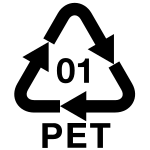
The RIC 1 symbol as it appears on the base of PET articles.
RICRIC — Resin Identification Code A numerical code moulded into the base of plastic articles to identify the polymer type, introduced by the Society of the Plastics Industry (now PLASTICS) in 1988 and represented by three chasing arrows forming a triangle with the number inside. Codes 1–7 cover the most common polymer families: 1 = PET, 2 = HDPE, 3 = PVC, 4 = LDPE, 5 = PP, 6 = PS, 7 = other. The RIC identifies the polymer backbone only — it says nothing about the additive package, food grade status, or GMP compliance. Food grade and industrial grade articles of the same polymer carry the same RIC code. symbol: Anton Poliakov, Wikimedia Commons, CC BY-SA 4.0. Modified: fill colour adapted for dark-mode display.
PETPET — Polyethylene terephthalate The plastic used in the FermZilla All Rounder, Oxebar mini keg, and PET bottles. Recycling code ♻️1. Extensively tested for food contact with carbonated beverages. Do not exceed 40 °C when cleaning. is clear and colourless at typical wall thicknesses, or amber-tinted where UV protection is added. It is rigid, glossy, and fractures cleanly under impact rather than yielding. The RICRIC — Resin Identification Code A numerical code moulded into the base of plastic articles to identify the polymer type, introduced by the Society of the Plastics Industry (now PLASTICS) in 1988 and represented by three chasing arrows forming a triangle with the number inside. Codes 1–7 cover the most common polymer families: 1 = PET, 2 = HDPE, 3 = PVC, 4 = LDPE, 5 = PP, 6 = PS, 7 = other. The RIC identifies the polymer backbone only — it says nothing about the additive package, food grade status, or GMP compliance. Food grade and industrial grade articles of the same polymer carry the same RIC code. 1 code is the most reliable identifier; in practice, any transparent, lightweight, rigid brewing vessel with a ♺1 marking on the base is almost certainly PETPET — Polyethylene terephthalate The plastic used in the FermZilla All Rounder, Oxebar mini keg, and PET bottles. Recycling code ♻️1. Extensively tested for food contact with carbonated beverages. Do not exceed 40 °C when cleaning..
Images showing typical PETPET — Polyethylene terephthalate The plastic used in the FermZilla All Rounder, Oxebar mini keg, and PET bottles. Recycling code ♻️1. Extensively tested for food contact with carbonated beverages. Do not exceed 40 °C when cleaning. articles in a homebrewing context — a FermZilla pressure fermenter body, a PETPET — Polyethylene terephthalate The plastic used in the FermZilla All Rounder, Oxebar mini keg, and PET bottles. Recycling code ♻️1. Extensively tested for food contact with carbonated beverages. Do not exceed 40 °C when cleaning. carboy, an Oxebar keg, a PETPET — Polyethylene terephthalate The plastic used in the FermZilla All Rounder, Oxebar mini keg, and PET bottles. Recycling code ♻️1. Extensively tested for food contact with carbonated beverages. Do not exceed 40 °C when cleaning. beer bottle, and the RICRIC — Resin Identification Code A numerical code moulded into the base of plastic articles to identify the polymer type, introduced by the Society of the Plastics Industry (now PLASTICS) in 1988 and represented by three chasing arrows forming a triangle with the number inside. Codes 1–7 cover the most common polymer families: 1 = PET, 2 = HDPE, 3 = PVC, 4 = LDPE, 5 = PP, 6 = PS, 7 = other. The RIC identifies the polymer backbone only — it says nothing about the additive package, food grade status, or GMP compliance. Food grade and industrial grade articles of the same polymer carry the same RIC code. 1 marking — are planned for this section.
Food grade status
PETPET — Polyethylene terephthalate The plastic used in the FermZilla All Rounder, Oxebar mini keg, and PET bottles. Recycling code ♻️1. Extensively tested for food contact with carbonated beverages. Do not exceed 40 °C when cleaning. has the most thoroughly documented food contact compliance ecosystem of any plastic in this register. That depth of documentation is driven by the global beverages industry, which packages beverages — both carbonated and non-carbonated — in PETPET — Polyethylene terephthalate The plastic used in the FermZilla All Rounder, Oxebar mini keg, and PET bottles. Recycling code ♻️1. Extensively tested for food contact with carbonated beverages. Do not exceed 40 °C when cleaning. at volumes measured in millions of tonnes annually.
Under EU Regulation 10/2011, PETPET — Polyethylene terephthalate The plastic used in the FermZilla All Rounder, Oxebar mini keg, and PET bottles. Recycling code ♻️1. Extensively tested for food contact with carbonated beverages. Do not exceed 40 °C when cleaning. is a positively listed polymer with established specific migration limitsSML — Specific Migration Limit The maximum permitted amount of a substance that may migrate from a food contact material into food or a food simulant, set by EU Regulation 10/2011. Expressed in mg/kg of food. for its monomers: terephthalic acid (SMLSML — Specific Migration Limit The maximum permitted amount of a substance that may migrate from a food contact material into food or a food simulant, set by EU Regulation 10/2011. Expressed in mg/kg of food. 7.5 mg/kg) and ethylene glycol (SMLSML — Specific Migration Limit The maximum permitted amount of a substance that may migrate from a food contact material into food or a food simulant, set by EU Regulation 10/2011. Expressed in mg/kg of food. 30 mg/kg). Both monomers have well-characterised toxicology profiles and are tested routinely in food contact applications.
The compliance testing context carries important practical weight. PETPET — Polyethylene terephthalate The plastic used in the FermZilla All Rounder, Oxebar mini keg, and PET bottles. Recycling code ♻️1. Extensively tested for food contact with carbonated beverages. Do not exceed 40 °C when cleaning. beverage bottles contact phosphoric acid (pH 2.5 in cola), citric and ascorbic acid (pH 2.0–2.5 in lemon and lime juice), citric acid (pH 2.5–3.5 in citrus drinks), and carbonic acid for weeks to months on retail shelves, often at temperatures above fermentation cellar conditions. That is a more aggressive contact scenario than any sanitiser or beer contact in homebrewing. Commercial producers obtain Declarations of ConformityDoC — Declaration of Conformity A manufacturer's written statement that a food contact material or article complies with the applicable EU regulations (primarily 1935/2004 and 10/2011). Required at each stage of the commercial supply chain, but not legally required to be provided to end consumers at retail. for their PETPET — Polyethylene terephthalate The plastic used in the FermZilla All Rounder, Oxebar mini keg, and PET bottles. Recycling code ♻️1. Extensively tested for food contact with carbonated beverages. Do not exceed 40 °C when cleaning. packaging under 10/2011 routinely — and homebrewers benefit indirectly from that compliance infrastructure when sourcing bottles and vessels from the same supply chains.
For Oxebar barrier PETPET — Polyethylene terephthalate The plastic used in the FermZilla All Rounder, Oxebar mini keg, and PET bottles. Recycling code ♻️1. Extensively tested for food contact with carbonated beverages. Do not exceed 40 °C when cleaning., the food contact surface is PETPET — Polyethylene terephthalate The plastic used in the FermZilla All Rounder, Oxebar mini keg, and PET bottles. Recycling code ♻️1. Extensively tested for food contact with carbonated beverages. Do not exceed 40 °C when cleaning. throughout — the barrier polymer component is dispersed within the PETPET — Polyethylene terephthalate The plastic used in the FermZilla All Rounder, Oxebar mini keg, and PET bottles. Recycling code ♻️1. Extensively tested for food contact with carbonated beverages. Do not exceed 40 °C when cleaning. matrix and not independently in food contact.
The full food contact compliance framework — what makes an article food grade, GMPGMP — Good Manufacturing Practice A set of regulated manufacturing requirements under EU Regulation 2023/2006 that food contact material producers must comply with. GMP covers controlled production environments, quality management systems, and traceability — ensuring that a food-approved resin is also processed in conditions that prevent contamination from non-food substances. A material can use an approved additive package and still fail GMP requirements if it is produced in a facility that also processes industrial compounds without adequate separation. requirements, EU simulant testing, DoCDoC — Declaration of Conformity A manufacturer's written statement that a food contact material or article complies with the applicable EU regulations (primarily 1935/2004 and 10/2011). Required at each stage of the commercial supply chain, but not legally required to be provided to end consumers at retail. structure, and what to do without one — is covered on the Food contact compliance page. The sections below cover only what is specific to PETPET — Polyethylene terephthalate The plastic used in the FermZilla All Rounder, Oxebar mini keg, and PET bottles. Recycling code ♻️1. Extensively tested for food contact with carbonated beverages. Do not exceed 40 °C when cleaning..
What makes a PET article food grade?
As with all thermoplastics, the polymer backbone is not the concern. PETPET — Polyethylene terephthalate The plastic used in the FermZilla All Rounder, Oxebar mini keg, and PET bottles. Recycling code ♻️1. Extensively tested for food contact with carbonated beverages. Do not exceed 40 °C when cleaning.'s monomers are well-regulated and the migration limits are achievable and routinely met. The distinction between food grade and industrial grade PETPET — Polyethylene terephthalate The plastic used in the FermZilla All Rounder, Oxebar mini keg, and PET bottles. Recycling code ♻️1. Extensively tested for food contact with carbonated beverages. Do not exceed 40 °C when cleaning. lies in the additive package — antioxidants, processing stabilisers, and any colourants must be from the EU 10/2011 approved list.
The RICRIC — Resin Identification Code A numerical code moulded into the base of plastic articles to identify the polymer type, introduced by the Society of the Plastics Industry (now PLASTICS) in 1988 and represented by three chasing arrows forming a triangle with the number inside. Codes 1–7 cover the most common polymer families: 1 = PET, 2 = HDPE, 3 = PVC, 4 = LDPE, 5 = PP, 6 = PS, 7 = other. The RIC identifies the polymer backbone only — it says nothing about the additive package, food grade status, or GMP compliance. Food grade and industrial grade articles of the same polymer carry the same RIC code. 1 code identifies the polymer class, not food grade status or GMPGMP — Good Manufacturing Practice A set of regulated manufacturing requirements under EU Regulation 2023/2006 that food contact material producers must comply with. GMP covers controlled production environments, quality management systems, and traceability — ensuring that a food-approved resin is also processed in conditions that prevent contamination from non-food substances. A material can use an approved additive package and still fail GMP requirements if it is produced in a facility that also processes industrial compounds without adequate separation. compliance. A food grade PETPET — Polyethylene terephthalate The plastic used in the FermZilla All Rounder, Oxebar mini keg, and PET bottles. Recycling code ♻️1. Extensively tested for food contact with carbonated beverages. Do not exceed 40 °C when cleaning. bottle and an industrial PETPET — Polyethylene terephthalate The plastic used in the FermZilla All Rounder, Oxebar mini keg, and PET bottles. Recycling code ♻️1. Extensively tested for food contact with carbonated beverages. Do not exceed 40 °C when cleaning. component may both carry RICRIC — Resin Identification Code A numerical code moulded into the base of plastic articles to identify the polymer type, introduced by the Society of the Plastics Industry (now PLASTICS) in 1988 and represented by three chasing arrows forming a triangle with the number inside. Codes 1–7 cover the most common polymer families: 1 = PET, 2 = HDPE, 3 = PVC, 4 = LDPE, 5 = PP, 6 = PS, 7 = other. The RIC identifies the polymer backbone only — it says nothing about the additive package, food grade status, or GMP compliance. Food grade and industrial grade articles of the same polymer carry the same RIC code. 1.
DoC availability for PET brewing articles
PETPET — Polyethylene terephthalate The plastic used in the FermZilla All Rounder, Oxebar mini keg, and PET bottles. Recycling code ♻️1. Extensively tested for food contact with carbonated beverages. Do not exceed 40 °C when cleaning. brewing articles from the homebrewing market typically carry a food grade claim but no publicly available DoCDoC — Declaration of Conformity A manufacturer's written statement that a food contact material or article complies with the applicable EU regulations (primarily 1935/2004 and 10/2011). Required at each stage of the commercial supply chain, but not legally required to be provided to end consumers at retail. — consistent with the pattern across the register. Where PETPET — Polyethylene terephthalate The plastic used in the FermZilla All Rounder, Oxebar mini keg, and PET bottles. Recycling code ♻️1. Extensively tested for food contact with carbonated beverages. Do not exceed 40 °C when cleaning. is sourced from food packaging supply chains (commercial beverage bottles), DoCsDoC — Declaration of Conformity A manufacturer's written statement that a food contact material or article complies with the applicable EU regulations (primarily 1935/2004 and 10/2011). Required at each stage of the commercial supply chain, but not legally required to be provided to end consumers at retail. are more readily obtainable. If sourcing PETPET — Polyethylene terephthalate The plastic used in the FermZilla All Rounder, Oxebar mini keg, and PET bottles. Recycling code ♻️1. Extensively tested for food contact with carbonated beverages. Do not exceed 40 °C when cleaning. bottles for homebrew use from a packaging supplier rather than a homebrew retailer, a DoCDoC — Declaration of Conformity A manufacturer's written statement that a food contact material or article complies with the applicable EU regulations (primarily 1935/2004 and 10/2011). Required at each stage of the commercial supply chain, but not legally required to be provided to end consumers at retail. referencing EU 1935/2004 and 10/2011 should be obtainable on request.
Temperature limits
Temperature is the defining operational constraint for PETPET — Polyethylene terephthalate The plastic used in the FermZilla All Rounder, Oxebar mini keg, and PET bottles. Recycling code ♻️1. Extensively tested for food contact with carbonated beverages. Do not exceed 40 °C when cleaning., and the one that most distinguishes it from the polyolefinsPolyolefin A class of polymers made by polymerising simple alkene (olefin) monomers — propylene for polypropylene, ethylene for polyethylene. The resulting polymer has an all-carbon backbone with no functional groups susceptible to hydrolysis, which is the primary reason polyolefins have excellent resistance to acids, alkalis, and aqueous environments. PP and HDPE are both polyolefins.. It governs all three use contexts differently.
Continuous use
PETPET — Polyethylene terephthalate The plastic used in the FermZilla All Rounder, Oxebar mini keg, and PET bottles. Recycling code ♻️1. Extensively tested for food contact with carbonated beverages. Do not exceed 40 °C when cleaning. performs well across the full range of fermentation and conditioning temperatures. Standard ale and lager fermentation (8–22 °C) presents no concern. High-temperature fermentation with Kveik and other thermophilic yeasts nominally runs up to 38–40 °C, which is at the material's limit rather than comfortably within it. Two practical considerations apply: active fermentation generates heat above ambient, so the vessel wall temperature can exceed the ambient temperature you're targeting; and heat sources applied directly to the vessel — heat belts, heat mats, or heat pads in contact with the PETPET — Polyethylene terephthalate The plastic used in the FermZilla All Rounder, Oxebar mini keg, and PET bottles. Recycling code ♻️1. Extensively tested for food contact with carbonated beverages. Do not exceed 40 °C when cleaning. body — are not recommended, as they can create localised hot spots above the bulk temperature. If you're fermenting warm with Kveik, consider whether a glass, HDPEHDPE — High-Density Polyethylene A polyolefin plastic used in fermenter taps and spray bottles. Slightly better chemical barrier properties than PP. EU Regulation 10/2011 compliant., or stainless vessel is the better choice. Rated A for standard fermentation and conditioning temperatures; approach the upper limit with awareness.
Cleaning
40 °C maximum for any cleaning solution. This is the limit confirmed by KegLand for FermZilla PET vessels1 and is consistent with the hydrolysisHydrolysis The chemical reaction in which a molecule is split by water, typically at a bond that connects two parts of the molecule. In food contact materials, hydrolysis is the primary mechanism by which acid or alkaline cleaning solutions attack susceptible polymers — particularly those with ester linkages (PET, Tritan, PC) or ether linkages (POM). Polymers with all-carbon backbones (PP, HDPE, PTFE) have no hydrolysable bonds and are inherently resistant to aqueous chemical attack. kinetics of PETPET — Polyethylene terephthalate The plastic used in the FermZilla All Rounder, Oxebar mini keg, and PET bottles. Recycling code ♻️1. Extensively tested for food contact with carbonated beverages. Do not exceed 40 °C when cleaning. in alkaline media. At 40 °C, alkaline cleaners remain slow enough to be safe at practical contact times. At 60 °C — standard for stainless CIPCIP — Clean-in-Place A method of cleaning the interior of pipework, vessels, and equipment without disassembly, using pumped cleaning and rinsing solutions. Standard in commercial and microbrewery settings. Requires dedicated CIP equipment and is out of scope for small-batch homebrewing. — ester hydrolysisHydrolysis The chemical reaction in which a molecule is split by water, typically at a bond that connects two parts of the molecule. In food contact materials, hydrolysis is the primary mechanism by which acid or alkaline cleaning solutions attack susceptible polymers — particularly those with ester linkages (PET, Tritan, PC) or ether linkages (POM). Polymers with all-carbon backbones (PP, HDPE, PTFE) have no hydrolysable bonds and are inherently resistant to aqueous chemical attack. in alkaline solution accelerates dramatically: visible surface cloudiness and structural degradation begin within the relevant contact window.
The 40 °C limit applies to the temperature of the cleaning solution, not to ambient temperature. Fill PETPET — Polyethylene terephthalate The plastic used in the FermZilla All Rounder, Oxebar mini keg, and PET bottles. Recycling code ♻️1. Extensively tested for food contact with carbonated beverages. Do not exceed 40 °C when cleaning. vessels with cleaning solution prepared at or below 40 °C. Do not fill hot and assume the vessel will protect itself as it cools.
For Oxebar barrier PETPET — Polyethylene terephthalate The plastic used in the FermZilla All Rounder, Oxebar mini keg, and PET bottles. Recycling code ♻️1. Extensively tested for food contact with carbonated beverages. Do not exceed 40 °C when cleaning., KegLand's stated maximum is 45 °C2, but cleaning practice should remain at 40 °C — the barrier polymer matrix or inter-layer bond is at additional risk from elevated temperature, and the 5 °C margin provides no justification for relaxed discipline.
Hot liquid contact — never
Never fill a PETPET — Polyethylene terephthalate The plastic used in the FermZilla All Rounder, Oxebar mini keg, and PET bottles. Recycling code ♻️1. Extensively tested for food contact with carbonated beverages. Do not exceed 40 °C when cleaning. vessel with hot wortWort Liquid extracted from malted grain during mashing and boiling, before fermentation. The starting point for beer., hot spargeSparging Rinsing the grain bed with hot water after mashing to wash out remaining fermentable sugars. In all-grain brewing, sparging recovers sugars that would otherwise be left behind in the grain. Common methods include batch sparging (adding water in discrete additions) and fly sparging (continuous slow rinsing). Not required for extract or partial mash brewing. water, or any liquid above 40 °C. This applies to PETPET — Polyethylene terephthalate The plastic used in the FermZilla All Rounder, Oxebar mini keg, and PET bottles. Recycling code ♻️1. Extensively tested for food contact with carbonated beverages. Do not exceed 40 °C when cleaning. beer bottles, FermZilla-type pressure fermenters, and Oxebar kegs without exception.
PETPET — Polyethylene terephthalate The plastic used in the FermZilla All Rounder, Oxebar mini keg, and PET bottles. Recycling code ♻️1. Extensively tested for food contact with carbonated beverages. Do not exceed 40 °C when cleaning.'s heat deflection temperatureHDT — Heat Deflection Temperature The temperature at which a polymer specimen deflects by a defined amount under a specified load, measured under standardised test conditions (ASTM D648 or ISO 75). HDT is a practical indicator of the upper service temperature for a structural plastic article under mechanical stress — above it, the material creeps and deforms rather than returning to its original shape. HDT varies substantially between polymer grades, wall thickness, and geometry, so a material's published HDT range is a guide; the specific article's rated service temperature from its manufacturer is the correct reference for any given use. under load sits in the range 65–80 °C depending on grade and crystallinity. Near-boilingBoiling Heating wort to a rolling boil (typically 60–90 minutes) to sterilise it, drive off unwanted compounds (including DMS precursors), concentrate sugars, and isomerise hop alpha acids into bitterness. Boiling is a hot-side process — it does not occur in Brew 1, which uses a pre-boiled kit. wortWort Liquid extracted from malted grain during mashing and boiling, before fermentation. The starting point for beer. causes immediate, irreversible deformation. WortWort Liquid extracted from malted grain during mashing and boiling, before fermentation. The starting point for beer. at 50–60 °C poses a deformation risk under the internal pressure of a sealed vessel even before the HDTHDT — Heat Deflection Temperature The temperature at which a polymer specimen deflects by a defined amount under a specified load, measured under standardised test conditions (ASTM D648 or ISO 75). HDT is a practical indicator of the upper service temperature for a structural plastic article under mechanical stress — above it, the material creeps and deforms rather than returning to its original shape. HDT varies substantially between polymer grades, wall thickness, and geometry, so a material's published HDT range is a guide; the specific article's rated service temperature from its manufacturer is the correct reference for any given use. is reached.
No-chill brewing is not compatible with PETPET — Polyethylene terephthalate The plastic used in the FermZilla All Rounder, Oxebar mini keg, and PET bottles. Recycling code ♻️1. Extensively tested for food contact with carbonated beverages. Do not exceed 40 °C when cleaning.. No-chill relies on transferringTransfer Moving beer from one vessel to another — most commonly from the fermenter to kegs or bottles for packaging. How the transfer is done affects oxygen pickup and contamination risk. Options range from simple gravity transfer via a tap, through hose-assisted filling, to fully closed CO₂-assisted transfer that minimises oxygen contact throughout. hot wortWort Liquid extracted from malted grain during mashing and boiling, before fermentation. The starting point for beer. directly into a sealed vessel and allowing it to cool slowly. This exposes the vessel wall to temperatures that will degrade PETPET — Polyethylene terephthalate The plastic used in the FermZilla All Rounder, Oxebar mini keg, and PET bottles. Recycling code ♻️1. Extensively tested for food contact with carbonated beverages. Do not exceed 40 °C when cleaning.. For no-chill-compatible vessel materials, see the no-chill process page. PETPET — Polyethylene terephthalate The plastic used in the FermZilla All Rounder, Oxebar mini keg, and PET bottles. Recycling code ♻️1. Extensively tested for food contact with carbonated beverages. Do not exceed 40 °C when cleaning. vessels should not be adapted for no-chill use regardless of design.
PPPP — Polypropylene A semi-crystalline polyolefin plastic widely used in fermenter buckets, lids, taps, and airlocks. Excellent chemical resistance across all homebrewing chemical environments. EU Regulation 10/2011 compliant. and HDPEHDPE — High-Density Polyethylene A polyolefin plastic used in fermenter taps and spray bottles. Slightly better chemical barrier properties than PP. EU Regulation 10/2011 compliant. tolerate hot wortWort Liquid extracted from malted grain during mashing and boiling, before fermentation. The starting point for beer. and hot cleaning solutions that are entirely off-limits for PETPET — Polyethylene terephthalate The plastic used in the FermZilla All Rounder, Oxebar mini keg, and PET bottles. Recycling code ♻️1. Extensively tested for food contact with carbonated beverages. Do not exceed 40 °C when cleaning.. Temperature constraint is one of PETPET — Polyethylene terephthalate The plastic used in the FermZilla All Rounder, Oxebar mini keg, and PET bottles. Recycling code ♻️1. Extensively tested for food contact with carbonated beverages. Do not exceed 40 °C when cleaning.'s meaningful practical limitations relative to those materials. The trade-off is optical clarity, lower wall thickness at equivalent strength, and better intrinsic gas barrier performance than either polyolefinPolyolefin A class of polymers made by polymerising simple alkene (olefin) monomers — propylene for polypropylene, ethylene for polyethylene. The resulting polymer has an all-carbon backbone with no functional groups susceptible to hydrolysis, which is the primary reason polyolefins have excellent resistance to acids, alkalis, and aqueous environments. PP and HDPE are both polyolefins..
Compatibility — ABNS: A
Working-dilution ABNSABNS — Acid-Based No-Rinse Sanitiser The class of acid-based sanitisers used in homebrewing, combining phosphoric acid with an anionic alkylbenzenesulfonate surfactant. The acid creates a low-pH environment hostile to microorganisms; the surfactant disrupts cell membranes. Examples: Star San, Sanipro Rinse, StellarSan, Chemsan. Approved for use on food-contact surfaces without rinsing when used at the manufacturer's specified dilution. sanitiser (StellarSan, Star SanSAN — Styrene-Acrylonitrile copolymer A transparent plastic used in some airlocks and equipment. The acrylonitrile content gives better chemical resistance than GPPS, particularly against DDBSA in acid-based sanitisers. Rated A for ABNS, unlike GPPS which is rated B/D., Sanipro Rinse, and equivalents) is compatible with PETPET — Polyethylene terephthalate The plastic used in the FermZilla All Rounder, Oxebar mini keg, and PET bottles. Recycling code ♻️1. Extensively tested for food contact with carbonated beverages. Do not exceed 40 °C when cleaning.. Both active components are considered separately.
Phosphoric acid component. PETPET — Polyethylene terephthalate The plastic used in the FermZilla All Rounder, Oxebar mini keg, and PET bottles. Recycling code ♻️1. Extensively tested for food contact with carbonated beverages. Do not exceed 40 °C when cleaning. rates A for dilute phosphoric acid at ambient temperature. At pH 3.0–3.5 and 20 °C, the ester hydrolysisHydrolysis The chemical reaction in which a molecule is split by water, typically at a bond that connects two parts of the molecule. In food contact materials, hydrolysis is the primary mechanism by which acid or alkaline cleaning solutions attack susceptible polymers — particularly those with ester linkages (PET, Tritan, PC) or ether linkages (POM). Polymers with all-carbon backbones (PP, HDPE, PTFE) have no hydrolysable bonds and are inherently resistant to aqueous chemical attack. rate is negligible in any brewing-relevant timeframe. The commercial context confirms this: PETPET — Polyethylene terephthalate The plastic used in the FermZilla All Rounder, Oxebar mini keg, and PET bottles. Recycling code ♻️1. Extensively tested for food contact with carbonated beverages. Do not exceed 40 °C when cleaning. beverage bottles contact phosphoric acid (pH 2.5 in cola) for weeks to months at retail without degradation. Working-dilution ABNSABNS — Acid-Based No-Rinse Sanitiser The class of acid-based sanitisers used in homebrewing, combining phosphoric acid with an anionic alkylbenzenesulfonate surfactant. The acid creates a low-pH environment hostile to microorganisms; the surfactant disrupts cell membranes. Examples: Star San, Sanipro Rinse, StellarSan, Chemsan. Approved for use on food-contact surfaces without rinsing when used at the manufacturer's specified dilution. at pH 3.0–3.5 for 30–60 seconds contact is a far less demanding scenario. The ISM chemical compatibility chart rates PETPET — Polyethylene terephthalate The plastic used in the FermZilla All Rounder, Oxebar mini keg, and PET bottles. Recycling code ♻️1. Extensively tested for food contact with carbonated beverages. Do not exceed 40 °C when cleaning. as A for phosphoric acid, consistent with this.3
DDBSADDBSA — Dodecylbenzenesulfonic acid The active surfactant in acid-based no-rinse sanitisers (ABNS). A long-chain anionic surfactant that disrupts microbial cell membranes at low pH. Non-volatile — it concentrates on surfaces as water evaporates. component. DDBSADDBSA — Dodecylbenzenesulfonic acid The active surfactant in acid-based no-rinse sanitisers (ABNS). A long-chain anionic surfactant that disrupts microbial cell membranes at low pH. Non-volatile — it concentrates on surfaces as water evaporates. (the anionic surfactant in ABNSABNS — Acid-Based No-Rinse Sanitiser The class of acid-based sanitisers used in homebrewing, combining phosphoric acid with an anionic alkylbenzenesulfonate surfactant. The acid creates a low-pH environment hostile to microorganisms; the surfactant disrupts cell membranes. Examples: Star San, Sanipro Rinse, StellarSan, Chemsan. Approved for use on food-contact surfaces without rinsing when used at the manufacturer's specified dilution. products) interacts with PETPET — Polyethylene terephthalate The plastic used in the FermZilla All Rounder, Oxebar mini keg, and PET bottles. Recycling code ♻️1. Extensively tested for food contact with carbonated beverages. Do not exceed 40 °C when cleaning. through a mechanism specific to PETPET — Polyethylene terephthalate The plastic used in the FermZilla All Rounder, Oxebar mini keg, and PET bottles. Recycling code ♻️1. Extensively tested for food contact with carbonated beverages. Do not exceed 40 °C when cleaning. among the polyolefinsPolyolefin A class of polymers made by polymerising simple alkene (olefin) monomers — propylene for polypropylene, ethylene for polyethylene. The resulting polymer has an all-carbon backbone with no functional groups susceptible to hydrolysis, which is the primary reason polyolefins have excellent resistance to acids, alkalis, and aqueous environments. PP and HDPE are both polyolefins.: pi–pi stacking between DDBSADDBSA — Dodecylbenzenesulfonic acid The active surfactant in acid-based no-rinse sanitisers (ABNS). A long-chain anionic surfactant that disrupts microbial cell membranes at low pH. Non-volatile — it concentrates on surfaces as water evaporates.'s aromatic ring and the terephthalate rings in the PETPET — Polyethylene terephthalate The plastic used in the FermZilla All Rounder, Oxebar mini keg, and PET bottles. Recycling code ♻️1. Extensively tested for food contact with carbonated beverages. Do not exceed 40 °C when cleaning. backbone. Unlike PPPP — Polypropylene A semi-crystalline polyolefin plastic widely used in fermenter buckets, lids, taps, and airlocks. Excellent chemical resistance across all homebrewing chemical environments. EU Regulation 10/2011 compliant. and HDPEHDPE — High-Density Polyethylene A polyolefin plastic used in fermenter taps and spray bottles. Slightly better chemical barrier properties than PP. EU Regulation 10/2011 compliant. — which contain no aromatic rings and resist DDBSADDBSA — Dodecylbenzenesulfonic acid The active surfactant in acid-based no-rinse sanitisers (ABNS). A long-chain anionic surfactant that disrupts microbial cell membranes at low pH. Non-volatile — it concentrates on surfaces as water evaporates. through their crystalline structure alone — PETPET — Polyethylene terephthalate The plastic used in the FermZilla All Rounder, Oxebar mini keg, and PET bottles. Recycling code ♻️1. Extensively tested for food contact with carbonated beverages. Do not exceed 40 °C when cleaning.'s terephthalate rings can participate in weak non-covalent pi–pi interactions with the dodecylbenzene component of DDBSADDBSA — Dodecylbenzenesulfonic acid The active surfactant in acid-based no-rinse sanitisers (ABNS). A long-chain anionic surfactant that disrupts microbial cell membranes at low pH. Non-volatile — it concentrates on surfaces as water evaporates..
This interaction is the same in family as the mechanism that makes polystyrene significantly more vulnerable to DDBSADDBSA — Dodecylbenzenesulfonic acid The active surfactant in acid-based no-rinse sanitisers (ABNS). A long-chain anionic surfactant that disrupts microbial cell membranes at low pH. Non-volatile — it concentrates on surfaces as water evaporates. — covered in detail on the PS/SAN page. PETPET — Polyethylene terephthalate The plastic used in the FermZilla All Rounder, Oxebar mini keg, and PET bottles. Recycling code ♻️1. Extensively tested for food contact with carbonated beverages. Do not exceed 40 °C when cleaning.'s susceptibility is substantially lower than PSPS — Polystyrene A family of transparent, rigid styrene-based plastics used in homebrewing airlocks and accessories. Three grades appear in this register: GPPS (General-Purpose Polystyrene), SAN (Styrene-Acrylonitrile copolymer), and Styrolux SBC (styrene-butadiene block copolymer). All three are visually indistinguishable. Grade is often unspecified by manufacturers — treat as GPPS if unknown, which is the most conservative assumption for ABNS and DES compatibility. for two reasons: the terephthalate rings are incorporated into the main chain (more sterically hindered than PSPS — Polystyrene A family of transparent, rigid styrene-based plastics used in homebrewing airlocks and accessories. Three grades appear in this register: GPPS (General-Purpose Polystyrene), SAN (Styrene-Acrylonitrile copolymer), and Styrolux SBC (styrene-butadiene block copolymer). All three are visually indistinguishable. Grade is often unspecified by manufacturers — treat as GPPS if unknown, which is the most conservative assumption for ABNS and DES compatibility.'s pendant phenyl groups), and PETPET — Polyethylene terephthalate The plastic used in the FermZilla All Rounder, Oxebar mini keg, and PET bottles. Recycling code ♻️1. Extensively tested for food contact with carbonated beverages. Do not exceed 40 °C when cleaning.'s semi-crystalline structure limits access to the susceptible amorphous regions.
At working dilution in a sealed vessel — whether for a 60-second sanitisation cycle or stored dilute ABNSABNS — Acid-Based No-Rinse Sanitiser The class of acid-based sanitisers used in homebrewing, combining phosphoric acid with an anionic alkylbenzenesulfonate surfactant. The acid creates a low-pH environment hostile to microorganisms; the surfactant disrupts cell membranes. Examples: Star San, Sanipro Rinse, StellarSan, Chemsan. Approved for use on food-contact surfaces without rinsing when used at the manufacturer's specified dilution. left in the tank between sessions — the interaction is minor and reversible. The key point is concentration: at working dilution, DDBSADDBSA — Dodecylbenzenesulfonic acid The active surfactant in acid-based no-rinse sanitisers (ABNS). A long-chain anionic surfactant that disrupts microbial cell membranes at low pH. Non-volatile — it concentrates on surfaces as water evaporates. remains at approximately 300 ppm and pH stays around 3.0–3.5, conditions under which ester hydrolysisHydrolysis The chemical reaction in which a molecule is split by water, typically at a bond that connects two parts of the molecule. In food contact materials, hydrolysis is the primary mechanism by which acid or alkaline cleaning solutions attack susceptible polymers — particularly those with ester linkages (PET, Tritan, PC) or ether linkages (POM). Polymers with all-carbon backbones (PP, HDPE, PTFE) have no hydrolysable bonds and are inherently resistant to aqueous chemical attack. is negligible and pi–pi stacking interaction is minimal. No structural consequence, no concern.
Under WDCWDC — Wet-Dry Cycle The process by which liquid applied to a surface evaporates, leaving non-volatile components concentrated as a dry residue. A single WDC deposits concentrated DDBSA and phosphoric acid on every sanitised surface. Repeated WDC events without cleaning cause residue to accumulate, progressively increasing exposure. Post-brew cleaning resets accumulation to zero. See: The wet-dry cycle model. cycling — where ABNSABNS — Acid-Based No-Rinse Sanitiser The class of acid-based sanitisers used in homebrewing, combining phosphoric acid with an anionic alkylbenzenesulfonate surfactant. The acid creates a low-pH environment hostile to microorganisms; the surfactant disrupts cell membranes. Examples: Star San, Sanipro Rinse, StellarSan, Chemsan. Approved for use on food-contact surfaces without rinsing when used at the manufacturer's specified dilution. residue concentrates progressively on surfaces that dry between uses — the concern is real but modest at Zone A — open surfaces (fermenter interior walls, bottle interior). At Zone B — confined geometry (thread roots, lid seal channels, tap fittings), concentrated DDBSADDBSA — Dodecylbenzenesulfonic acid The active surfactant in acid-based no-rinse sanitisers (ABNS). A long-chain anionic surfactant that disrupts microbial cell membranes at low pH. Non-volatile — it concentrates on surfaces as water evaporates. residue has sustained contact with the surface at an elevated effective concentration, which warrants periodic inspection for surface cloudiness or micro-crazing.
The WDCWDC — Wet-Dry Cycle The process by which liquid applied to a surface evaporates, leaving non-volatile components concentrated as a dry residue. A single WDC deposits concentrated DDBSA and phosphoric acid on every sanitised surface. Repeated WDC events without cleaning cause residue to accumulate, progressively increasing exposure. Post-brew cleaning resets accumulation to zero. See: The wet-dry cycle model. model and zone definitions are set out on the WDC model page. For PETPET — Polyethylene terephthalate The plastic used in the FermZilla All Rounder, Oxebar mini keg, and PET bottles. Recycling code ♻️1. Extensively tested for food contact with carbonated beverages. Do not exceed 40 °C when cleaning. pressure vessels with fittings, Zone B is the primary location to monitor over service life.
A quantified WDCWDC — Wet-Dry Cycle The process by which liquid applied to a surface evaporates, leaving non-volatile components concentrated as a dry residue. A single WDC deposits concentrated DDBSA and phosphoric acid on every sanitised surface. Repeated WDC events without cleaning cause residue to accumulate, progressively increasing exposure. Post-brew cleaning resets accumulation to zero. See: The wet-dry cycle model. cycle analysis for PETPET — Polyethylene terephthalate The plastic used in the FermZilla All Rounder, Oxebar mini keg, and PET bottles. Recycling code ♻️1. Extensively tested for food contact with carbonated beverages. Do not exceed 40 °C when cleaning. — showing DDBSADDBSA — Dodecylbenzenesulfonic acid The active surfactant in acid-based no-rinse sanitisers (ABNS). A long-chain anionic surfactant that disrupts microbial cell membranes at low pH. Non-volatile — it concentrates on surfaces as water evaporates. and phosphoric acid accumulation by zone against the concern threshold, equivalent to the PPPP — Polypropylene A semi-crystalline polyolefin plastic widely used in fermenter buckets, lids, taps, and airlocks. Excellent chemical resistance across all homebrewing chemical environments. EU Regulation 10/2011 compliant. page chart — is planned for this section. This requires confirming PETPET — Polyethylene terephthalate The plastic used in the FermZilla All Rounder, Oxebar mini keg, and PET bottles. Recycling code ♻️1. Extensively tested for food contact with carbonated beverages. Do not exceed 40 °C when cleaning.-specific ESCESC — Environmental Stress Cracking Failure of a polymer under the combined action of mechanical stress and chemical exposure. The failure mode of POM DuoTight collars under repeated ABNS WDC cycles. Occurs below the material's normal stress threshold when chemical exposure is present. threshold data.
Structural vs migration. These are distinct concerns. The WDCWDC — Wet-Dry Cycle The process by which liquid applied to a surface evaporates, leaving non-volatile components concentrated as a dry residue. A single WDC deposits concentrated DDBSA and phosphoric acid on every sanitised surface. Repeated WDC events without cleaning cause residue to accumulate, progressively increasing exposure. Post-brew cleaning resets accumulation to zero. See: The wet-dry cycle model.-driven DDBSADDBSA — Dodecylbenzenesulfonic acid The active surfactant in acid-based no-rinse sanitisers (ABNS). A long-chain anionic surfactant that disrupts microbial cell membranes at low pH. Non-volatile — it concentrates on surfaces as water evaporates. accumulation at Zone B is a structural concern — concentrated surfactant at a mechanically stressed interface risks ESCESC — Environmental Stress Cracking Failure of a polymer under the combined action of mechanical stress and chemical exposure. The failure mode of POM DuoTight collars under repeated ABNS WDC cycles. Occurs below the material's normal stress threshold when chemical exposure is present., not a migration event. Migration of PETPET — Polyethylene terephthalate The plastic used in the FermZilla All Rounder, Oxebar mini keg, and PET bottles. Recycling code ♻️1. Extensively tested for food contact with carbonated beverages. Do not exceed 40 °C when cleaning. monomers into beer is a separate question governed by the food contact compliance framework: at homebrewing temperatures and contact times, migration from compliant undamaged PETPET — Polyethylene terephthalate The plastic used in the FermZilla All Rounder, Oxebar mini keg, and PET bottles. Recycling code ♻️1. Extensively tested for food contact with carbonated beverages. Do not exceed 40 °C when cleaning. is a fraction of the conservative EU simulant test conditions. A damaged PETPET — Polyethylene terephthalate The plastic used in the FermZilla All Rounder, Oxebar mini keg, and PET bottles. Recycling code ♻️1. Extensively tested for food contact with carbonated beverages. Do not exceed 40 °C when cleaning. surface — one showing cloudiness, crazing, or dimensional change — has an unknown, not necessarily elevated, migration profile, and should be retired.
The DuoTight case study — in which DDBSADDBSA — Dodecylbenzenesulfonic acid The active surfactant in acid-based no-rinse sanitisers (ABNS). A long-chain anionic surfactant that disrupts microbial cell membranes at low pH. Non-volatile — it concentrates on surfaces as water evaporates. WDCWDC — Wet-Dry Cycle The process by which liquid applied to a surface evaporates, leaving non-volatile components concentrated as a dry residue. A single WDC deposits concentrated DDBSA and phosphoric acid on every sanitised surface. Repeated WDC events without cleaning cause residue to accumulate, progressively increasing exposure. Post-brew cleaning resets accumulation to zero. See: The wet-dry cycle model. accumulation caused progressive structural failure in POMPOM — Polyoxymethylene Also known as acetal or Delrin. An engineering thermoplastic used in John Guest push-fit fittings and older DuoTight collars. Susceptible to acid-catalysed chain-unzipping under WDC conditions, releasing formaldehyde. Rated D–X for ABNS.→ Full details fittings — illustrates the structural failure mechanism. POMPOM — Polyoxymethylene Also known as acetal or Delrin. An engineering thermoplastic used in John Guest push-fit fittings and older DuoTight collars. Susceptible to acid-catalysed chain-unzipping under WDC conditions, releasing formaldehyde. Rated D–X for ABNS.→ Full details and PETPET — Polyethylene terephthalate The plastic used in the FermZilla All Rounder, Oxebar mini keg, and PET bottles. Recycling code ♻️1. Extensively tested for food contact with carbonated beverages. Do not exceed 40 °C when cleaning. fail through different chemical routes, but the structural concern (Zone B geometry, concentrated residue, mechanical load) is the same in family. See the DuoTight case study for the worked WDCWDC — Wet-Dry Cycle The process by which liquid applied to a surface evaporates, leaving non-volatile components concentrated as a dry residue. A single WDC deposits concentrated DDBSA and phosphoric acid on every sanitised surface. Repeated WDC events without cleaning cause residue to accumulate, progressively increasing exposure. Post-brew cleaning resets accumulation to zero. See: The wet-dry cycle model. failure analysis.
Practical guidance. Use ABNSABNS — Acid-Based No-Rinse Sanitiser The class of acid-based sanitisers used in homebrewing, combining phosphoric acid with an anionic alkylbenzenesulfonate surfactant. The acid creates a low-pH environment hostile to microorganisms; the surfactant disrupts cell membranes. Examples: Star San, Sanipro Rinse, StellarSan, Chemsan. Approved for use on food-contact surfaces without rinsing when used at the manufacturer's specified dilution. for PETPET — Polyethylene terephthalate The plastic used in the FermZilla All Rounder, Oxebar mini keg, and PET bottles. Recycling code ♻️1. Extensively tested for food contact with carbonated beverages. Do not exceed 40 °C when cleaning. sanitisation as intended — fill or coat, maintain contact time, drain. Rinse any spills from external surfaces promptly; dried ABNSABNS — Acid-Based No-Rinse Sanitiser The class of acid-based sanitisers used in homebrewing, combining phosphoric acid with an anionic alkylbenzenesulfonate surfactant. The acid creates a low-pH environment hostile to microorganisms; the surfactant disrupts cell membranes. Examples: Star San, Sanipro Rinse, StellarSan, Chemsan. Approved for use on food-contact surfaces without rinsing when used at the manufacturer's specified dilution. residue on exterior threads and fittings contributes to WDCWDC — Wet-Dry Cycle The process by which liquid applied to a surface evaporates, leaving non-volatile components concentrated as a dry residue. A single WDC deposits concentrated DDBSA and phosphoric acid on every sanitised surface. Repeated WDC events without cleaning cause residue to accumulate, progressively increasing exposure. Post-brew cleaning resets accumulation to zero. See: The wet-dry cycle model. accumulation. Clean the vessel after use to reset the WDCWDC — Wet-Dry Cycle The process by which liquid applied to a surface evaporates, leaving non-volatile components concentrated as a dry residue. A single WDC deposits concentrated DDBSA and phosphoric acid on every sanitised surface. Repeated WDC events without cleaning cause residue to accumulate, progressively increasing exposure. Post-brew cleaning resets accumulation to zero. See: The wet-dry cycle model. cycle before the next brew. Stored dilute ABNSABNS — Acid-Based No-Rinse Sanitiser The class of acid-based sanitisers used in homebrewing, combining phosphoric acid with an anionic alkylbenzenesulfonate surfactant. The acid creates a low-pH environment hostile to microorganisms; the surfactant disrupts cell membranes. Examples: Star San, Sanipro Rinse, StellarSan, Chemsan. Approved for use on food-contact surfaces without rinsing when used at the manufacturer's specified dilution. in a sealed vessel does not create WDCWDC — Wet-Dry Cycle The process by which liquid applied to a surface evaporates, leaving non-volatile components concentrated as a dry residue. A single WDC deposits concentrated DDBSA and phosphoric acid on every sanitised surface. Repeated WDC events without cleaning cause residue to accumulate, progressively increasing exposure. Post-brew cleaning resets accumulation to zero. See: The wet-dry cycle model. conditions — concentration stays at working dilution without evaporation — so leaving dilute ABNSABNS — Acid-Based No-Rinse Sanitiser The class of acid-based sanitisers used in homebrewing, combining phosphoric acid with an anionic alkylbenzenesulfonate surfactant. The acid creates a low-pH environment hostile to microorganisms; the surfactant disrupts cell membranes. Examples: Star San, Sanipro Rinse, StellarSan, Chemsan. Approved for use on food-contact surfaces without rinsing when used at the manufacturer's specified dilution. in the tank between sessions is chemically safe for the PETPET — Polyethylene terephthalate The plastic used in the FermZilla All Rounder, Oxebar mini keg, and PET bottles. Recycling code ♻️1. Extensively tested for food contact with carbonated beverages. Do not exceed 40 °C when cleaning.. The better argument for making fresh solution each time is efficacy: dilute ABNSABNS — Acid-Based No-Rinse Sanitiser The class of acid-based sanitisers used in homebrewing, combining phosphoric acid with an anionic alkylbenzenesulfonate surfactant. The acid creates a low-pH environment hostile to microorganisms; the surfactant disrupts cell membranes. Examples: Star San, Sanipro Rinse, StellarSan, Chemsan. Approved for use on food-contact surfaces without rinsing when used at the manufacturer's specified dilution. loses sanitising effectiveness as the peroxy equilibrium shifts over days. Make what you need, when you need it.
Compatibility — DES: A
DESDES — Disinfectant Ethanol Sanitiser ChemiPro DES. An ethanol-based (70–80%) sanitiser with no non-volatile residue. Evaporates completely, leaving no WDC risk. A-rated for all common homebrewing materials. (ethanol-based sanitiser) at 70–80% has no meaningful interaction with PETPET — Polyethylene terephthalate The plastic used in the FermZilla All Rounder, Oxebar mini keg, and PET bottles. Recycling code ♻️1. Extensively tested for food contact with carbonated beverages. Do not exceed 40 °C when cleaning. at typical contact times. PETPET — Polyethylene terephthalate The plastic used in the FermZilla All Rounder, Oxebar mini keg, and PET bottles. Recycling code ♻️1. Extensively tested for food contact with carbonated beverages. Do not exceed 40 °C when cleaning. is rated for ethanol at all concentrations encountered in homebrewing use. No concern.
Compatibility — cleaning: A†
PETPET — Polyethylene terephthalate The plastic used in the FermZilla All Rounder, Oxebar mini keg, and PET bottles. Recycling code ♻️1. Extensively tested for food contact with carbonated beverages. Do not exceed 40 °C when cleaning. has the most complex cleaning compatibility profile in this register. The three cleaner categories behave differently. The constraints on PETPET — Polyethylene terephthalate The plastic used in the FermZilla All Rounder, Oxebar mini keg, and PET bottles. Recycling code ♻️1. Extensively tested for food contact with carbonated beverages. Do not exceed 40 °C when cleaning. pressure fermenters and kegs are stricter than for plain PETPET — Polyethylene terephthalate The plastic used in the FermZilla All Rounder, Oxebar mini keg, and PET bottles. Recycling code ♻️1. Extensively tested for food contact with carbonated beverages. Do not exceed 40 °C when cleaning. bottles, but the reason is not the PETPET — Polyethylene terephthalate The plastic used in the FermZilla All Rounder, Oxebar mini keg, and PET bottles. Recycling code ♻️1. Extensively tested for food contact with carbonated beverages. Do not exceed 40 °C when cleaning. material itself — it is geometry and mechanical stress. A PETPET — Polyethylene terephthalate The plastic used in the FermZilla All Rounder, Oxebar mini keg, and PET bottles. Recycling code ♻️1. Extensively tested for food contact with carbonated beverages. Do not exceed 40 °C when cleaning. soda bottle stores carbonated beer without issue. The difference with a pressure fermenter is one of stress geometry and sustained mechanical load: pressure vessel fittings — threaded ports, lid threads, O-ring seats under torque — create Zone B geometry where cleaner can concentrate and dwell, and sustained CO₂ pressure creates ESCESC — Environmental Stress Cracking Failure of a polymer under the combined action of mechanical stress and chemical exposure. The failure mode of POM DuoTight collars under repeated ABNS WDC cycles. Occurs below the material's normal stress threshold when chemical exposure is present.-relevant mechanical stress. A PETPET — Polyethylene terephthalate The plastic used in the FermZilla All Rounder, Oxebar mini keg, and PET bottles. Recycling code ♻️1. Extensively tested for food contact with carbonated beverages. Do not exceed 40 °C when cleaning. bottle does have a threaded neck and geometric transitions, but it operates at lower sustained pressure, the thread is single-use or low-cycle, and there are no O-ring interfaces under sustained compression. The risk profile differs in degree, not in kind.
The sequence is always clean first, then sanitise. Rinse cleaning solution thoroughly from PETPET — Polyethylene terephthalate The plastic used in the FermZilla All Rounder, Oxebar mini keg, and PET bottles. Recycling code ♻️1. Extensively tested for food contact with carbonated beverages. Do not exceed 40 °C when cleaning. vessels before applying ABNSABNS — Acid-Based No-Rinse Sanitiser The class of acid-based sanitisers used in homebrewing, combining phosphoric acid with an anionic alkylbenzenesulfonate surfactant. The acid creates a low-pH environment hostile to microorganisms; the surfactant disrupts cell membranes. Examples: Star San, Sanipro Rinse, StellarSan, Chemsan. Approved for use on food-contact surfaces without rinsing when used at the manufacturer's specified dilution..
Oxidising cleaners (StellarOxy, ChemiPro OXI) — A
KegLand explicitly recommends StellarOxy1 as the primary cleaner for FermZilla PETPET — Polyethylene terephthalate The plastic used in the FermZilla All Rounder, Oxebar mini keg, and PET bottles. Recycling code ♻️1. Extensively tested for food contact with carbonated beverages. Do not exceed 40 °C when cleaning. fermenters, and oxidising percarbonate cleaners (StellarOxy, ChemiPro OXI) are the preferred cleaning choice for PETPET — Polyethylene terephthalate The plastic used in the FermZilla All Rounder, Oxebar mini keg, and PET bottles. Recycling code ♻️1. Extensively tested for food contact with carbonated beverages. Do not exceed 40 °C when cleaning. across all vessel types. They work through an oxidative mechanism that does not attack ester linkages preferentially, and are effective on beer residues at cold and warm water temperatures with no contact time restriction beyond the 40 °C maximum that applies to all PETPET — Polyethylene terephthalate The plastic used in the FermZilla All Rounder, Oxebar mini keg, and PET bottles. Recycling code ♻️1. Extensively tested for food contact with carbonated beverages. Do not exceed 40 °C when cleaning. cleaning.
For standard fermentation soiling — yeast cake, beer film, light protein deposits — extending the StellarOxy soak to 30–60 minutes with agitation is more effective than the default 15–20 minutes. For very heavy soiling, a second fresh solution is more effective than extending a single soak beyond 60 minutes, as the active hydrogen peroxide is consumed and the remaining solution is weakly alkaline sodium carbonate with little oxidative activity. For heavy hop resin accumulation specifically — which requires alkaline saponificationSaponify The chemical reaction between a fatty acid and an alkali to form soap (a soluble salt of the fatty acid) and glycerol. In brewing cleaning, alkaline cleaners saponify the lipid components of yeast cell walls and hop resins, converting them into water-soluble compounds that can be rinsed away. rather than oxidation — StellarClean (with the 30-minute PETPET — Polyethylene terephthalate The plastic used in the FermZilla All Rounder, Oxebar mini keg, and PET bottles. Recycling code ♻️1. Extensively tested for food contact with carbonated beverages. Do not exceed 40 °C when cleaning. time limit) is genuinely the better tool; extended StellarOxy does not fully substitute.
High-metasilicate alkaline cleaners (StellarClean, ChemiPro Wash, ChemClean) — A*
Alkaline cleaners containing significant sodium metasilicate — StellarClean, ChemiPro Wash, ChemClean — are conditionally suitable for PETPET — Polyethylene terephthalate The plastic used in the FermZilla All Rounder, Oxebar mini keg, and PET bottles. Recycling code ♻️1. Extensively tested for food contact with carbonated beverages. Do not exceed 40 °C when cleaning. at cold or warm water temperatures (≤40 °C), with a 30-minute maximum contact time and immediate, thorough rinsing afterwards.
The 30-minute limit is not arbitrary. At working concentration and ambient temperature, measurable surface changes begin on PETPET — Polyethylene terephthalate The plastic used in the FermZilla All Rounder, Oxebar mini keg, and PET bottles. Recycling code ♻️1. Extensively tested for food contact with carbonated beverages. Do not exceed 40 °C when cleaning. around this window — cloudiness and the onset of detectable ester hydrolysisHydrolysis The chemical reaction in which a molecule is split by water, typically at a bond that connects two parts of the molecule. In food contact materials, hydrolysis is the primary mechanism by which acid or alkaline cleaning solutions attack susceptible polymers — particularly those with ester linkages (PET, Tritan, PC) or ether linkages (POM). Polymers with all-carbon backbones (PP, HDPE, PTFE) have no hydrolysable bonds and are inherently resistant to aqueous chemical attack.. In practice, 15–20 minutes with moderate agitation is sufficient for typical beer residue on most PETPET — Polyethylene terephthalate The plastic used in the FermZilla All Rounder, Oxebar mini keg, and PET bottles. Recycling code ♻️1. Extensively tested for food contact with carbonated beverages. Do not exceed 40 °C when cleaning. surfaces, leaving margin before the limit. KegLand's FermZilla All-Rounder cleaning guide1 is explicit: "Do not leave StellarClean in the vessel for longer than 30 minutes as this can damage the tank." For heavy soiling where a longer soak is needed, KegLand's guidance is to switch to StellarOxy, which may be left overnight.1 KegLand's Oxebar cleaning video4 is stricter still: "Do not over-soak: Limit detergent contact to a maximum of 15 minutes to protect the plastic."
The 30-minute limit applies at ambient temperature. Do not use these cleaners hot on PETPET — Polyethylene terephthalate The plastic used in the FermZilla All Rounder, Oxebar mini keg, and PET bottles. Recycling code ♻️1. Extensively tested for food contact with carbonated beverages. Do not exceed 40 °C when cleaning.: the combination of pH >12 and elevated temperature accelerates hydrolysisHydrolysis The chemical reaction in which a molecule is split by water, typically at a bond that connects two parts of the molecule. In food contact materials, hydrolysis is the primary mechanism by which acid or alkaline cleaning solutions attack susceptible polymers — particularly those with ester linkages (PET, Tritan, PC) or ether linkages (POM). Polymers with all-carbon backbones (PP, HDPE, PTFE) have no hydrolysable bonds and are inherently resistant to aqueous chemical attack. significantly beyond what the time limit provides protection against.
Within stated limits only — exceeding the contact time or temperature degrades this rating rapidly.
Phosphate-based alkaline cleaners (Grainfather High Performance Cleaner) — A
Grainfather High Performance Cleaner uses sodium tripolyphosphate (STPP) as its primary alkaline agent rather than sodium metasilicate. STPP is a milder alkaline agent than metasilicate at equivalent concentration, and the phosphate-based formulation presents no ester hydrolysisHydrolysis The chemical reaction in which a molecule is split by water, typically at a bond that connects two parts of the molecule. In food contact materials, hydrolysis is the primary mechanism by which acid or alkaline cleaning solutions attack susceptible polymers — particularly those with ester linkages (PET, Tritan, PC) or ether linkages (POM). Polymers with all-carbon backbones (PP, HDPE, PTFE) have no hydrolysable bonds and are inherently resistant to aqueous chemical attack. concern for PETPET — Polyethylene terephthalate The plastic used in the FermZilla All Rounder, Oxebar mini keg, and PET bottles. Recycling code ♻️1. Extensively tested for food contact with carbonated beverages. Do not exceed 40 °C when cleaning. at homebrewing concentrations and contact times. Rating: A, no contact time restriction beyond the 40 °C maximum that applies to all PETPET — Polyethylene terephthalate The plastic used in the FermZilla All Rounder, Oxebar mini keg, and PET bottles. Recycling code ♻️1. Extensively tested for food contact with carbonated beverages. Do not exceed 40 °C when cleaning. cleaning.
Five Star PBW — A*
KegLand markets StellarClean as Powerful Brewery Wash (PBWPBW — Powdered Brewery Wash A sodium metasilicate and percarbonate-based alkaline cleaner widely used in brewing. Removes organic soil through alkaline hydrolysis. A-rated for all common homebrewing plastic and elastomer materials at working concentrations.); Five Star makes a separate product, Powdered Brewery Wash. Both use the abbreviation — in this section PBWPBW — Powdered Brewery Wash A sodium metasilicate and percarbonate-based alkaline cleaner widely used in brewing. Removes organic soil through alkaline hydrolysis. A-rated for all common homebrewing plastic and elastomer materials at working concentrations. means Five Star's product. StellarClean is rated separately above.
Five Star PBWPBW — Powdered Brewery Wash A sodium metasilicate and percarbonate-based alkaline cleaner widely used in brewing. Removes organic soil through alkaline hydrolysis. A-rated for all common homebrewing plastic and elastomer materials at working concentrations. is a high-metasilicate alkaline cleaner in the same category as StellarClean. KegLand's cleaning guide does not list it — but KegLand recommends their own products throughout their documentation, and the absence of a mention is not a recommendation against. PBWPBW — Powdered Brewery Wash A sodium metasilicate and percarbonate-based alkaline cleaner widely used in brewing. Removes organic soil through alkaline hydrolysis. A-rated for all common homebrewing plastic and elastomer materials at working concentrations.'s formulation varies by market: EU-market labels show sodium metasilicate at 20–35%, which is comparable to or higher than StellarClean. It should be treated identically: A* with the same 30-minute contact time limit on PETPET — Polyethylene terephthalate The plastic used in the FermZilla All Rounder, Oxebar mini keg, and PET bottles. Recycling code ♻️1. Extensively tested for food contact with carbonated beverages. Do not exceed 40 °C when cleaning., cold water, immediate rinsing. The same logic applies as to StellarClean — effective for heavy soiling, but StellarOxy is the lower-risk default for routine cleaning.
If your brewery uses both PETPET — Polyethylene terephthalate The plastic used in the FermZilla All Rounder, Oxebar mini keg, and PET bottles. Recycling code ♻️1. Extensively tested for food contact with carbonated beverages. Do not exceed 40 °C when cleaning. vessels (FermZilla, Oxebar, PETPET — Polyethylene terephthalate The plastic used in the FermZilla All Rounder, Oxebar mini keg, and PET bottles. Recycling code ♻️1. Extensively tested for food contact with carbonated beverages. Do not exceed 40 °C when cleaning. bottles) and polyolefinPolyolefin A class of polymers made by polymerising simple alkene (olefin) monomers — propylene for polypropylene, ethylene for polyethylene. The resulting polymer has an all-carbon backbone with no functional groups susceptible to hydrolysis, which is the primary reason polyolefins have excellent resistance to acids, alkalis, and aqueous environments. PP and HDPE are both polyolefins. vessels (PPPP — Polypropylene A semi-crystalline polyolefin plastic widely used in fermenter buckets, lids, taps, and airlocks. Excellent chemical resistance across all homebrewing chemical environments. EU Regulation 10/2011 compliant. buckets, HDPEHDPE — High-Density Polyethylene A polyolefin plastic used in fermenter taps and spray bottles. Slightly better chemical barrier properties than PP. EU Regulation 10/2011 compliant. cubes), StellarOxy is the better single-cleaner choice for the whole fleet. It is unrestricted on all of them. StellarClean and Five Star PBWPBW — Powdered Brewery Wash A sodium metasilicate and percarbonate-based alkaline cleaner widely used in brewing. Removes organic soil through alkaline hydrolysis. A-rated for all common homebrewing plastic and elastomer materials at working concentrations. are more powerful on heavy protein and hop soiling but introduce PETPET — Polyethylene terephthalate The plastic used in the FermZilla All Rounder, Oxebar mini keg, and PET bottles. Recycling code ♻️1. Extensively tested for food contact with carbonated beverages. Do not exceed 40 °C when cleaning.-specific time discipline and the risk of forgetting which vessel you are cleaning. StellarOxy handles standard beer residue effectively for most homebrewing scenarios; for sessions with heavy trubTrub The layer of sediment that collects at the bottom of the fermenter during and after fermentation. Composed of dead yeast cells, hop particles, and proteins precipitated during the boil (hot break) or cooling (cold break). Beers transferred off the trub are cleaner and clearer, but a small volume loss is inevitable — typically 0.5 to 1 litre per batch depending on fermenter geometry and dry hop additions. or hop matter, 15–20 minutes with agitation is usually sufficient. The only scenario where a metasilicate cleaner adds meaningful value is persistent soiling that percarbonate genuinely cannot shift — and even then, switching for that specific clean (with discipline) is preferable to using it routinely on PETPET — Polyethylene terephthalate The plastic used in the FermZilla All Rounder, Oxebar mini keg, and PET bottles. Recycling code ♻️1. Extensively tested for food contact with carbonated beverages. Do not exceed 40 °C when cleaning..
Pure percarbonate cleaners work oxidatively with minimal ester hydrolysisHydrolysis The chemical reaction in which a molecule is split by water, typically at a bond that connects two parts of the molecule. In food contact materials, hydrolysis is the primary mechanism by which acid or alkaline cleaning solutions attack susceptible polymers — particularly those with ester linkages (PET, Tritan, PC) or ether linkages (POM). Polymers with all-carbon backbones (PP, HDPE, PTFE) have no hydrolysable bonds and are inherently resistant to aqueous chemical attack. risk. High-metasilicate cleaners — StellarClean, ChemiPro Wash, Five Star PBWPBW — Powdered Brewery Wash A sodium metasilicate and percarbonate-based alkaline cleaner widely used in brewing. Removes organic soil through alkaline hydrolysis. A-rated for all common homebrewing plastic and elastomer materials at working concentrations. — add a strong alkaline component that begins attacking ester linkages above the 30-minute threshold. The mechanism is the same across all three; the time limit applies equally.
† PETPET — Polyethylene terephthalate The plastic used in the FermZilla All Rounder, Oxebar mini keg, and PET bottles. Recycling code ♻️1. Extensively tested for food contact with carbonated beverages. Do not exceed 40 °C when cleaning. cleaning: unrestricted (A) for oxidising cleaners. Conditional (A*) for high-metasilicate alkaline cleaners (StellarClean, ChemiPro Wash, Five Star PBWPBW — Powdered Brewery Wash A sodium metasilicate and percarbonate-based alkaline cleaner widely used in brewing. Removes organic soil through alkaline hydrolysis. A-rated for all common homebrewing plastic and elastomer materials at working concentrations.) within a 30-minute contact limit at ≤40 °C.
Compatibility — beer/wort: A
Beer at fermentation and storage conditions
Beer at pH 4.0–4.5, 4–8% ABVABV — Alcohol By Volume The percentage of alcohol in a finished beer, expressed as a volume fraction. Calculated from the difference between original gravity (OG) and final gravity (FG) after fermentation is complete: ABV = (OG − FG) × 131.25. A typical homebrew ale runs 4–6% ABV; strong beers can exceed 10%., at 0–40 °C for weeks to months: A. This is exactly the condition under which PETPET — Polyethylene terephthalate The plastic used in the FermZilla All Rounder, Oxebar mini keg, and PET bottles. Recycling code ♻️1. Extensively tested for food contact with carbonated beverages. Do not exceed 40 °C when cleaning. beverage packaging operates commercially, including beer. No material concern across the full fermentation temperature range, including high-temperature Kveik fermentation approaching 40 °C.
Sour beer
Lactic acid and acetic acid at sour beer concentrations (pH 3.2–3.8) present no additional concern beyond what standard beer contact covers. The acid hydrolysisHydrolysis The chemical reaction in which a molecule is split by water, typically at a bond that connects two parts of the molecule. In food contact materials, hydrolysis is the primary mechanism by which acid or alkaline cleaning solutions attack susceptible polymers — particularly those with ester linkages (PET, Tritan, PC) or ether linkages (POM). Polymers with all-carbon backbones (PP, HDPE, PTFE) have no hydrolysable bonds and are inherently resistant to aqueous chemical attack. rate at sour beer pH and fermentation temperatures is negligible over any practical timescale. A.
Wort — temperature governs
WortWort Liquid extracted from malted grain during mashing and boiling, before fermentation. The starting point for beer. at pitchingPitch To add yeast to wort to begin fermentation. Pitching rate — the quantity of yeast added relative to the volume and strength of the wort — affects fermentation speed, yeast health, and flavour. For BrewClub brews, a single packet of dried yeast is the correct pitch rate for a standard kit batch. temperature (18–22 °C, or up to 38–40 °C for Kveik) contacts PETPET — Polyethylene terephthalate The plastic used in the FermZilla All Rounder, Oxebar mini keg, and PET bottles. Recycling code ♻️1. Extensively tested for food contact with carbonated beverages. Do not exceed 40 °C when cleaning. as a matter of routine in PETPET — Polyethylene terephthalate The plastic used in the FermZilla All Rounder, Oxebar mini keg, and PET bottles. Recycling code ♻️1. Extensively tested for food contact with carbonated beverages. Do not exceed 40 °C when cleaning. fermenters — no concern. Hot wortWort Liquid extracted from malted grain during mashing and boiling, before fermentation. The starting point for beer. above 40 °C is incompatible with PETPET — Polyethylene terephthalate The plastic used in the FermZilla All Rounder, Oxebar mini keg, and PET bottles. Recycling code ♻️1. Extensively tested for food contact with carbonated beverages. Do not exceed 40 °C when cleaning. for structural reasons set out in Temperature limits. No-chill is off-limits regardless of intent. A at pitchingPitch To add yeast to wort to begin fermentation. Pitching rate — the quantity of yeast added relative to the volume and strength of the wort — affects fermentation speed, yeast health, and flavour. For BrewClub brews, a single packet of dried yeast is the correct pitch rate for a standard kit batch. temperature; X above 40 °C.
Oxygen ingress
Oxygen ingress through the PETPET — Polyethylene terephthalate The plastic used in the FermZilla All Rounder, Oxebar mini keg, and PET bottles. Recycling code ♻️1. Extensively tested for food contact with carbonated beverages. Do not exceed 40 °C when cleaning. wall is a material property, not a compatibility issue. It is relevant because it sets a practical shelf-life ceiling for certain styles packaged in standard PETPET — Polyethylene terephthalate The plastic used in the FermZilla All Rounder, Oxebar mini keg, and PET bottles. Recycling code ♻️1. Extensively tested for food contact with carbonated beverages. Do not exceed 40 °C when cleaning..
For a 500 mL standard PETPET — Polyethylene terephthalate The plastic used in the FermZilla All Rounder, Oxebar mini keg, and PET bottles. Recycling code ♻️1. Extensively tested for food contact with carbonated beverages. Do not exceed 40 °C when cleaning. bottle, the oxygen transmission rate (OTROTR — Oxygen Transmission Rate A measure of how quickly oxygen permeates through a packaging material. Lower OTR means better oxygen barrier and longer shelf life for packaged beer. Multilayer PET (Oxebar) and stainless steel have significantly lower OTR than plain PET.) is approximately 0.04–0.08 mL O₂/day at ambient conditions — approximately 1.1–2.2 mL cumulative over four weeks of bottle conditioning. Robust stouts, strong ales, and malt-forward styles tolerate this level of ingress; residual yeast activity and the beer's own reducing chemistry partially compensate. Hop-forward and haze-forward styles — IPAs, pale ales, and especially New England IPAs (NEIPAsNEIPA — New England India Pale Ale A hazy, hop-forward IPA style characterised by high dry hop additions, soft bitterness, and haze from hop oils and proteins. Among the most oxidation-sensitive styles in common homebrewing — oxygen exposure causes rapid flavour degradation. PET bottle conditioning imposes a meaningful shelf-life limitation for NEIPA; Oxebar barrier PET or stainless kegging is strongly preferred for extended storage.) — are sensitive to oxidation at this scale. NEIPAsNEIPA — New England India Pale Ale A hazy, hop-forward IPA style characterised by high dry hop additions, soft bitterness, and haze from hop oils and proteins. Among the most oxidation-sensitive styles in common homebrewing — oxygen exposure causes rapid flavour degradation. PET bottle conditioning imposes a meaningful shelf-life limitation for NEIPA; Oxebar barrier PET or stainless kegging is strongly preferred for extended storage. are arguably the most susceptible style in common homebrewing: high dry hop load, haze-forming proteins that interact readily with oxygen, low bitterness that masks nothing, and typically consumed young when any oxidation damage is immediately apparent. Standard PETPET — Polyethylene terephthalate The plastic used in the FermZilla All Rounder, Oxebar mini keg, and PET bottles. Recycling code ♻️1. Extensively tested for food contact with carbonated beverages. Do not exceed 40 °C when cleaning. bottle conditioning imposes a practical shelf-life limitation for these beers regardless of packaging hygiene.
UV transparency and skunking
Standard PETPET — Polyethylene terephthalate The plastic used in the FermZilla All Rounder, Oxebar mini keg, and PET bottles. Recycling code ♻️1. Extensively tested for food contact with carbonated beverages. Do not exceed 40 °C when cleaning. is UV-transparent. This has two practical consequences:
For fermenters (pro): optical clarity lets you observe fermentation activity, yeast settlement, and clarity development without opening the vessel. This is a genuine advantage over opaque PPPP — Polypropylene A semi-crystalline polyolefin plastic widely used in fermenter buckets, lids, taps, and airlocks. Excellent chemical resistance across all homebrewing chemical environments. EU Regulation 10/2011 compliant. or HDPEHDPE — High-Density Polyethylene A polyolefin plastic used in fermenter taps and spray bottles. Slightly better chemical barrier properties than PP. EU Regulation 10/2011 compliant. fermenters.
For packaging (con): UV and short-wavelength visible light (350–500 nm) degrades iso-alpha acids in hopped beer through a radical reaction, producing 3-methyl-2-butene-1-thiol (3-MBT) — the compound responsible for the "skunked" off-flavour. 3-MBT has a detection threshold of approximately 4 parts per trillion; even brief light exposure is enough to cause detectable damage in sensitive styles. Clear PETPET — Polyethylene terephthalate The plastic used in the FermZilla All Rounder, Oxebar mini keg, and PET bottles. Recycling code ♻️1. Extensively tested for food contact with carbonated beverages. Do not exceed 40 °C when cleaning. bottles offer no protection against this mechanism. Lager, pale ale, and NEIPANEIPA — New England India Pale Ale A hazy, hop-forward IPA style characterised by high dry hop additions, soft bitterness, and haze from hop oils and proteins. Among the most oxidation-sensitive styles in common homebrewing — oxygen exposure causes rapid flavour degradation. PET bottle conditioning imposes a meaningful shelf-life limitation for NEIPA; Oxebar barrier PET or stainless kegging is strongly preferred for extended storage. are the most susceptible styles; dark beers with low iso-alpha acid content are less affected.
Amber-tinted PETPET — Polyethylene terephthalate The plastic used in the FermZilla All Rounder, Oxebar mini keg, and PET bottles. Recycling code ♻️1. Extensively tested for food contact with carbonated beverages. Do not exceed 40 °C when cleaning. — used in the 20L Oxebar — absorbs the damaging wavelengths and provides meaningful light protection. If using clear PETPET — Polyethylene terephthalate The plastic used in the FermZilla All Rounder, Oxebar mini keg, and PET bottles. Recycling code ♻️1. Extensively tested for food contact with carbonated beverages. Do not exceed 40 °C when cleaning. bottles or kegs for light-sensitive styles, store them in darkness or use opaque sleeves.
UV degradation of PETPET — Polyethylene terephthalate The plastic used in the FermZilla All Rounder, Oxebar mini keg, and PET bottles. Recycling code ♻️1. Extensively tested for food contact with carbonated beverages. Do not exceed 40 °C when cleaning. itself: UV also degrades the PETPET — Polyethylene terephthalate The plastic used in the FermZilla All Rounder, Oxebar mini keg, and PET bottles. Recycling code ♻️1. Extensively tested for food contact with carbonated beverages. Do not exceed 40 °C when cleaning. material over time through photo-oxidation, causing yellowing and embrittlement. KegLand explicitly note that keeping FermZilla vessels out of direct sunlight is essential.5 This is a separate concern from skunking — the vessel itself is being damaged, not just the beer. Store all PETPET — Polyethylene terephthalate The plastic used in the FermZilla All Rounder, Oxebar mini keg, and PET bottles. Recycling code ♻️1. Extensively tested for food contact with carbonated beverages. Do not exceed 40 °C when cleaning. fermenters and kegs away from direct sunlight as a matter of routine.
Oxebar — barrier PET as a packaging solution
Oxebar was originally a separate Australian company (Oxebar Australia) specialising in polymer containers and oxygen barrier packaging technology. The brand and technology were absorbed into KegLand, and "Oxebar" is now KegLand's product line name for their barrier PETPET — Polyethylene terephthalate The plastic used in the FermZilla All Rounder, Oxebar mini keg, and PET bottles. Recycling code ♻️1. Extensively tested for food contact with carbonated beverages. Do not exceed 40 °C when cleaning. keg range.
All current Oxebar keg products — 4L, 8L, and 20L — appear to use the same construction: a PETPET — Polyethylene terephthalate The plastic used in the FermZilla All Rounder, Oxebar mini keg, and PET bottles. Recycling code ♻️1. Extensively tested for food contact with carbonated beverages. Do not exceed 40 °C when cleaning. polymer blend with barrier properties, claimed by KegLand to give approximately 3× better oxygen barrier than standard PETPET — Polyethylene terephthalate The plastic used in the FermZilla All Rounder, Oxebar mini keg, and PET bottles. Recycling code ♻️1. Extensively tested for food contact with carbonated beverages. Do not exceed 40 °C when cleaning..26 KegLand use at least three names for this across their product pages: Oxebar Mono, Oxebar Monolayer, and Mono Barrier PETPET — Polyethylene terephthalate The plastic used in the FermZilla All Rounder, Oxebar mini keg, and PET bottles. Recycling code ♻️1. Extensively tested for food contact with carbonated beverages. Do not exceed 40 °C when cleaning. Polymer Matrix. All three appear to describe the same material. The 4L ball lock tapping draught pack is the same keg bundled with a tapping head — the vessel itself is identical. Confirmation from KegLand of the barrier polymer composition would be welcome.
The Oxebar range is the practical homebrewing answer to PETPET — Polyethylene terephthalate The plastic used in the FermZilla All Rounder, Oxebar mini keg, and PET bottles. Recycling code ♻️1. Extensively tested for food contact with carbonated beverages. Do not exceed 40 °C when cleaning. oxygen ingress. The table below compares recommended storage duration for Oxebar (Mono/Monolayer) against estimated shelf life for standard PETPET — Polyethylene terephthalate The plastic used in the FermZilla All Rounder, Oxebar mini keg, and PET bottles. Recycling code ♻️1. Extensively tested for food contact with carbonated beverages. Do not exceed 40 °C when cleaning. bottles, by style and storage temperature. Oxebar figures are from KegLand's product documentation.2 Standard PETPET — Polyethylene terephthalate The plastic used in the FermZilla All Rounder, Oxebar mini keg, and PET bottles. Recycling code ♻️1. Extensively tested for food contact with carbonated beverages. Do not exceed 40 °C when cleaning. estimates are derived from the OTROTR — Oxygen Transmission Rate A measure of how quickly oxygen permeates through a packaging material. Lower OTR means better oxygen barrier and longer shelf life for packaged beer. Multilayer PET (Oxebar) and stainless steel have significantly lower OTR than plain PET. data above and are not from a manufacturer source.
| Beer style | Standard PETPET — Polyethylene terephthalate The plastic used in the FermZilla All Rounder, Oxebar mini keg, and PET bottles. Recycling code ♻️1. Extensively tested for food contact with carbonated beverages. Do not exceed 40 °C when cleaning. — cold (2 °C) | Standard PETPET — Polyethylene terephthalate The plastic used in the FermZilla All Rounder, Oxebar mini keg, and PET bottles. Recycling code ♻️1. Extensively tested for food contact with carbonated beverages. Do not exceed 40 °C when cleaning. — ambient (25 °C) | Oxebar Mono — cold (2 °C) | Oxebar Mono — ambient (25 °C) |
|---|---|---|---|---|
| Light coloured, hazy, hoppy (incl. NEIPANEIPA — New England India Pale Ale A hazy, hop-forward IPA style characterised by high dry hop additions, soft bitterness, and haze from hop oils and proteins. Among the most oxidation-sensitive styles in common homebrewing — oxygen exposure causes rapid flavour degradation. PET bottle conditioning imposes a meaningful shelf-life limitation for NEIPA; Oxebar barrier PET or stainless kegging is strongly preferred for extended storage.) | ~3–4 weeks | ~1–2 weeks | 6 months | 2 months |
| Amber beers, porters, summer ales | ~6–8 weeks | ~2–3 weeks | 9 months | 3 months |
| Dark beers, stouts, triples | ~3–4 months | ~4–6 weeks | 15 months | 5 months |
Choosing between packaging options — standard PETPET — Polyethylene terephthalate The plastic used in the FermZilla All Rounder, Oxebar mini keg, and PET bottles. Recycling code ♻️1. Extensively tested for food contact with carbonated beverages. Do not exceed 40 °C when cleaning., Oxebar, glass, or stainless keg — is covered in the packaging guide.
PET vs PP and HDPE as fermentation vessels
Oxygen ingress is not just a packaging concern — it also matters during fermentation and conditioning when beer sits in the vessel for weeks. This is where PETPET — Polyethylene terephthalate The plastic used in the FermZilla All Rounder, Oxebar mini keg, and PET bottles. Recycling code ♻️1. Extensively tested for food contact with carbonated beverages. Do not exceed 40 °C when cleaning. offers a meaningful advantage over PPPP — Polypropylene A semi-crystalline polyolefin plastic widely used in fermenter buckets, lids, taps, and airlocks. Excellent chemical resistance across all homebrewing chemical environments. EU Regulation 10/2011 compliant. and HDPEHDPE — High-Density Polyethylene A polyolefin plastic used in fermenter taps and spray bottles. Slightly better chemical barrier properties than PP. EU Regulation 10/2011 compliant. fermenters. KegLand state explicitly that the FermZilla's PETPET — Polyethylene terephthalate The plastic used in the FermZilla All Rounder, Oxebar mini keg, and PET bottles. Recycling code ♻️1. Extensively tested for food contact with carbonated beverages. Do not exceed 40 °C when cleaning. wall is a better gas barrier than PP or HDPE,7 and that HDPEHDPE — High-Density Polyethylene A polyolefin plastic used in fermenter taps and spray bottles. Slightly better chemical barrier properties than PP. EU Regulation 10/2011 compliant. fermenters can be porous enough to carry flavour and aroma from one batch to another.5 Standard PETPET — Polyethylene terephthalate The plastic used in the FermZilla All Rounder, Oxebar mini keg, and PET bottles. Recycling code ♻️1. Extensively tested for food contact with carbonated beverages. Do not exceed 40 °C when cleaning. OTROTR — Oxygen Transmission Rate A measure of how quickly oxygen permeates through a packaging material. Lower OTR means better oxygen barrier and longer shelf life for packaged beer. Multilayer PET (Oxebar) and stainless steel have significantly lower OTR than plain PET. is already substantially lower than HDPEHDPE — High-Density Polyethylene A polyolefin plastic used in fermenter taps and spray bottles. Slightly better chemical barrier properties than PP. EU Regulation 10/2011 compliant. at typical wall thicknesses; the practical implication for a homebrewer keeping beer in a fermenter for 2–4 weeks is real, if modest. For closed-transferTransfer Moving beer from one vessel to another — most commonly from the fermenter to kegs or bottles for packaging. How the transfer is done affects oxygen pickup and contamination risk. Options range from simple gravity transfer via a tap, through hose-assisted filling, to fully closed CO₂-assisted transfer that minimises oxygen contact throughout. brewing with pressure fermentation and kegging, PETPET — Polyethylene terephthalate The plastic used in the FermZilla All Rounder, Oxebar mini keg, and PET bottles. Recycling code ♻️1. Extensively tested for food contact with carbonated beverages. Do not exceed 40 °C when cleaning.'s oxygen barrier is a genuine advantage over HDPEHDPE — High-Density Polyethylene A polyolefin plastic used in fermenter taps and spray bottles. Slightly better chemical barrier properties than PP. EU Regulation 10/2011 compliant. or PPPP — Polypropylene A semi-crystalline polyolefin plastic widely used in fermenter buckets, lids, taps, and airlocks. Excellent chemical resistance across all homebrewing chemical environments. EU Regulation 10/2011 compliant. buckets.
Stainless steel is effectively impermeable to oxygen and remains the reference standard. For long conditioning periods or oxygen-sensitive styles, a PETPET — Polyethylene terephthalate The plastic used in the FermZilla All Rounder, Oxebar mini keg, and PET bottles. Recycling code ♻️1. Extensively tested for food contact with carbonated beverages. Do not exceed 40 °C when cleaning. pressure fermenter closed under CO₂ is the practical plastic alternative.
Barrier PET — Oxebar construction and cleaning
The Oxebar construction variants and their implications for cleaning compatibility are covered here. Barrier performance and packaging choice are discussed under Oxygen ingress above.
Construction
KegLand describe Oxebar as a PETPET — Polyethylene terephthalate The plastic used in the FermZilla All Rounder, Oxebar mini keg, and PET bottles. Recycling code ♻️1. Extensively tested for food contact with carbonated beverages. Do not exceed 40 °C when cleaning. polymer blend — their PCO38 kegs video6 refers to PETPET — Polyethylene terephthalate The plastic used in the FermZilla All Rounder, Oxebar mini keg, and PET bottles. Recycling code ♻️1. Extensively tested for food contact with carbonated beverages. Do not exceed 40 °C when cleaning. and nylon being blended together, though this is a simplified marketing description rather than a technical specification. The specific barrier polymer, its grade, and the precise blend composition have not been confirmed by KegLand in formal documentation. What is confirmed from KegLand's own sources is that Oxebar is a single-layer polymer blend (not a laminate), and that the food contact surface is PETPET — Polyethylene terephthalate The plastic used in the FermZilla All Rounder, Oxebar mini keg, and PET bottles. Recycling code ♻️1. Extensively tested for food contact with carbonated beverages. Do not exceed 40 °C when cleaning. throughout.
Chemical compatibility
Chemical compatibility analysis is identical to plain PETPET — Polyethylene terephthalate The plastic used in the FermZilla All Rounder, Oxebar mini keg, and PET bottles. Recycling code ♻️1. Extensively tested for food contact with carbonated beverages. Do not exceed 40 °C when cleaning. for all Oxebar constructions: the same 40 °C temperature limit, the same cleaner ratings, the same ABNSABNS — Acid-Based No-Rinse Sanitiser The class of acid-based sanitisers used in homebrewing, combining phosphoric acid with an anionic alkylbenzenesulfonate surfactant. The acid creates a low-pH environment hostile to microorganisms; the surfactant disrupts cell membranes. Examples: Star San, Sanipro Rinse, StellarSan, Chemsan. Approved for use on food-contact surfaces without rinsing when used at the manufacturer's specified dilution. profile. The barrier polymer component is within the PETPET — Polyethylene terephthalate The plastic used in the FermZilla All Rounder, Oxebar mini keg, and PET bottles. Recycling code ♻️1. Extensively tested for food contact with carbonated beverages. Do not exceed 40 °C when cleaning. matrix and not independently in food contact. Based on available information, the blend has good general chemical resistance at homebrewing concentrations — no additional compatibility concern has been identified, but KegLand confirmation of the specific barrier polymer would allow this to be stated with more precision.
The additional constraint for Oxebar
The barrier polymer component in the Oxebar blend may respond differently to elevated temperature or sustained alkaline exposure than plain PETPET — Polyethylene terephthalate The plastic used in the FermZilla All Rounder, Oxebar mini keg, and PET bottles. Recycling code ♻️1. Extensively tested for food contact with carbonated beverages. Do not exceed 40 °C when cleaning.. This is an additional reason to hold strictly to 40 °C maximum for Oxebar cleaning, separate from the plain-PETPET — Polyethylene terephthalate The plastic used in the FermZilla All Rounder, Oxebar mini keg, and PET bottles. Recycling code ♻️1. Extensively tested for food contact with carbonated beverages. Do not exceed 40 °C when cleaning. hydrolysisHydrolysis The chemical reaction in which a molecule is split by water, typically at a bond that connects two parts of the molecule. In food contact materials, hydrolysis is the primary mechanism by which acid or alkaline cleaning solutions attack susceptible polymers — particularly those with ester linkages (PET, Tritan, PC) or ether linkages (POM). Polymers with all-carbon backbones (PP, HDPE, PTFE) have no hydrolysable bonds and are inherently resistant to aqueous chemical attack. concern. KegLand's stated 45 °C maximum2 is a ceiling, not a target.
ESC and pressure — structural failure risk
This section discusses structural failure risk in the context of PETPET — Polyethylene terephthalate The plastic used in the FermZilla All Rounder, Oxebar mini keg, and PET bottles. Recycling code ♻️1. Extensively tested for food contact with carbonated beverages. Do not exceed 40 °C when cleaning., but the underlying safety principles apply to all pressurised vessels regardless of material — PET fermenters and PET bottles (this page), glass bottles (material), stainless kegs (material). Pressure vessel failure can cause serious injury. The material determines how and when failure may occur; the consequences of failure are determined by the pressure stored. This topic is covered on each relevant material page and in the equipment guides. A dedicated pressure safety overview is planned.
PETPET — Polyethylene terephthalate The plastic used in the FermZilla All Rounder, Oxebar mini keg, and PET bottles. Recycling code ♻️1. Extensively tested for food contact with carbonated beverages. Do not exceed 40 °C when cleaning. pressure vessels used under CO₂ introduce a structural failure risk not present in atmospheric-use articles. This distinction matters: structural failure in a pressurised vessel is a physical safety concern, not just a material or flavour concern. A cracked or burst PETPET — Polyethylene terephthalate The plastic used in the FermZilla All Rounder, Oxebar mini keg, and PET bottles. Recycling code ♻️1. Extensively tested for food contact with carbonated beverages. Do not exceed 40 °C when cleaning. pressure vessel under carbonation pressure can cause injury.
Environmental stress crackingESC — Environmental Stress Cracking Failure of a polymer under the combined action of mechanical stress and chemical exposure. The failure mode of POM DuoTight collars under repeated ABNS WDC cycles. Occurs below the material's normal stress threshold when chemical exposure is present. requires both a susceptible material and sustained mechanical stress. The pressure level varies significantly by vessel type and filling method — and not always in the direction you might expect:
- Force-carbonated keg: regulated pressure, typically 10–15 PSI at serving temperature. Controlled by the gas regulator (which has its own PRV) and the keg's own PRV. Constant and well-bounded — assuming the regulator is set correctly and the PRV is clean and functional.
- Pressure-fermented FermZilla: CO₂ generated by fermentation, controlled by a spunding valve set to the target pressure and a PRV as a safety ceiling (typically 10–15 PSI). Both devices together keep pressure within a defined, safe range — assuming both are set correctly, free of krausenKrausen The thick, rocky foam layer that forms on top of fermenting wort during active fermentation. Produced by CO₂ rising through the liquid and carrying proteins, hop compounds, and yeast cells to the surface. Krausen typically peaks within the first 24–72 hours of fermentation and then falls back into the beer as activity slows. It is normal and harmless. The fermenter needs enough headspace to accommodate it — typically at least 20% of the batch volume — or it can push out through the airlock. or debris that could cause them to stick, and functioning as intended.
- Bottle filled from keg: same dissolved CO₂ as the keg at filling, but once sealed the pressure is unregulated — determined by headspace volume and temperature. No PRV, no pressure relief of any kind.
- Bottle-conditioned PETPET — Polyethylene terephthalate The plastic used in the FermZilla All Rounder, Oxebar mini keg, and PET bottles. Recycling code ♻️1. Extensively tested for food contact with carbonated beverages. Do not exceed 40 °C when cleaning. bottle: priming sugar generates CO₂ with no pressure relief whatsoever. Pressure is determined entirely by the amount of fermentable extract, temperature, and headspace. There is no spunding valve, no PRV, no regulator — nothing between the bottle and failure except the structural limit of the vessel itself. Over-primed or warm bottle-conditioned PETPET — Polyethylene terephthalate The plastic used in the FermZilla All Rounder, Oxebar mini keg, and PET bottles. Recycling code ♻️1. Extensively tested for food contact with carbonated beverages. Do not exceed 40 °C when cleaning. bottles can and do fail catastrophically — "bottle bombs" are a well-documented homebrewing hazard. This is where ESCESC — Environmental Stress Cracking Failure of a polymer under the combined action of mechanical stress and chemical exposure. The failure mode of POM DuoTight collars under repeated ABNS WDC cycles. Occurs below the material's normal stress threshold when chemical exposure is present. risk is greatest for PETPET — Polyethylene terephthalate The plastic used in the FermZilla All Rounder, Oxebar mini keg, and PET bottles. Recycling code ♻️1. Extensively tested for food contact with carbonated beverages. Do not exceed 40 °C when cleaning. specifically, and where the consequences of structural failure are most serious.
Chemical stress compounds mechanical stress. DDBSADDBSA — Dodecylbenzenesulfonic acid The active surfactant in acid-based no-rinse sanitisers (ABNS). A long-chain anionic surfactant that disrupts microbial cell membranes at low pH. Non-volatile — it concentrates on surfaces as water evaporates. residue accumulation at Zone B — confined geometry interfaces (O-ring seats, lid threads under torque) and Zone C — compressed contact under sustained stress geometries adds chemical susceptibility on top of mechanical load.
Hydrostatic testing. KegLand strongly recommends periodic hydrostatic testing of both Oxebar kegs2 and FermZilla pressure fermenters — every two years, with a full test procedure in their Hydro Test Guide.8 The test is done with the vessel filled to the brim with water (not CO₂ or air — water is incompressible, so a failure during the test is safe). Given the low cost of Oxebar kegs, replacing them on the two-year schedule rather than retesting is a reasonable alternative. For FermZilla fermenters, note that the tank has a stamped date — do not use under pressure past that date without hydrotesting first.
Practical implications:
- Inspect thread interfaces, lid seals, and O-ring seats for cloudiness, crazing, or micro-cracking at each brew
- Retire any vessel showing visible surface degradation at a stressed interface — if you see cloudiness, crazing, or deformation, replace it. The compliance testing was done on undamaged material; for damaged PETPET — Polyethylene terephthalate The plastic used in the FermZilla All Rounder, Oxebar mini keg, and PET bottles. Recycling code ♻️1. Extensively tested for food contact with carbonated beverages. Do not exceed 40 °C when cleaning. the migration risk is low (the products are terephthalic acid and ethylene glycol, both with established SMLsSML — Specific Migration Limit The maximum permitted amount of a substance that may migrate from a food contact material into food or a food simulant, set by EU Regulation 10/2011. Expressed in mg/kg of food.) but unquantified. When in doubt, replace rather than continue using.
- Replace O-rings and lid seals on the manufacturer's schedule, not at first leakage
- Follow KegLand's two-year hydrostatic test schedule for Oxebar kegs and FermZilla fermenters
- For bottle-conditioned PETPET — Polyethylene terephthalate The plastic used in the FermZilla All Rounder, Oxebar mini keg, and PET bottles. Recycling code ♻️1. Extensively tested for food contact with carbonated beverages. Do not exceed 40 °C when cleaning. bottles: accurate priming calculations, consistent fermentation temperature, and conservative headspace reduce pressure uncertainty
PET in homebrewing — the practical picture
PETPET — Polyethylene terephthalate The plastic used in the FermZilla All Rounder, Oxebar mini keg, and PET bottles. Recycling code ♻️1. Extensively tested for food contact with carbonated beverages. Do not exceed 40 °C when cleaning. is a well-founded fermentation and packaging material within its operational limits. Its food contact credentials are the strongest of any plastic in this register, backed by decades of commercial beverage packaging data. Within the temperature envelope, it performs reliably across all brewing chemicals encountered in good practice.
Where PETPET — Polyethylene terephthalate The plastic used in the FermZilla All Rounder, Oxebar mini keg, and PET bottles. Recycling code ♻️1. Extensively tested for food contact with carbonated beverages. Do not exceed 40 °C when cleaning. excels. Packaging: PETPET — Polyethylene terephthalate The plastic used in the FermZilla All Rounder, Oxebar mini keg, and PET bottles. Recycling code ♻️1. Extensively tested for food contact with carbonated beverages. Do not exceed 40 °C when cleaning. beer bottles are the standard alternative to glass at homebrew scale — lighter, shatterproof, and food contact compliant from well-documented supply chains. PETPET — Polyethylene terephthalate The plastic used in the FermZilla All Rounder, Oxebar mini keg, and PET bottles. Recycling code ♻️1. Extensively tested for food contact with carbonated beverages. Do not exceed 40 °C when cleaning. pressure fermenters: optically clear, lightweight, and chemically compatible with the full brewing process within temperature limits. Oxebar barrier PETPET — Polyethylene terephthalate The plastic used in the FermZilla All Rounder, Oxebar mini keg, and PET bottles. Recycling code ♻️1. Extensively tested for food contact with carbonated beverages. Do not exceed 40 °C when cleaning. kegs: the improved barrier matrix meaningfully extends shelf life for sensitive styles versus standard PETPET — Polyethylene terephthalate The plastic used in the FermZilla All Rounder, Oxebar mini keg, and PET bottles. Recycling code ♻️1. Extensively tested for food contact with carbonated beverages. Do not exceed 40 °C when cleaning. bottles.
Migration. PETPET — Polyethylene terephthalate The plastic used in the FermZilla All Rounder, Oxebar mini keg, and PET bottles. Recycling code ♻️1. Extensively tested for food contact with carbonated beverages. Do not exceed 40 °C when cleaning.'s monomers — terephthalic acid (SMLSML — Specific Migration Limit The maximum permitted amount of a substance that may migrate from a food contact material into food or a food simulant, set by EU Regulation 10/2011. Expressed in mg/kg of food. 7.5 mg/kg) and ethylene glycol (SMLSML — Specific Migration Limit The maximum permitted amount of a substance that may migrate from a food contact material into food or a food simulant, set by EU Regulation 10/2011. Expressed in mg/kg of food. 30 mg/kg) — are among the best-characterised food contact migration products in the plastics register. Both limits are set accepting low-level migration and routinely met by compliant PETPET — Polyethylene terephthalate The plastic used in the FermZilla All Rounder, Oxebar mini keg, and PET bottles. Recycling code ♻️1. Extensively tested for food contact with carbonated beverages. Do not exceed 40 °C when cleaning. packaging. EU 10/2011 simulant testing is conducted at 60 °C over 10 days — conditions more aggressive than any homebrewing scenario. At fermentation temperatures and conditioning periods, actual migration from undamaged, compliant PETPET — Polyethylene terephthalate The plastic used in the FermZilla All Rounder, Oxebar mini keg, and PET bottles. Recycling code ♻️1. Extensively tested for food contact with carbonated beverages. Do not exceed 40 °C when cleaning. is a fraction of those test-condition figures. The open question — as with all plastics — is whether repeated cleaning and sanitising contact slowly depletes or alters the additive package over many cycles; this has not been characterised for homebrewing conditions. If the vessel is visibly undamaged and sourced from a food-contact supply chain, migration is not a meaningful concern. If it shows visible damage — cloudiness, crazing, deformation — retire it. The compliance data no longer applies to a damaged surface.
Where the constraints bind. The 40 °C temperature ceiling is a hard limit. No hot wortWort Liquid extracted from malted grain during mashing and boiling, before fermentation. The starting point for beer., no hot cleaning solutions, no no-chill. For any brewing practice that requires hot liquid contact with the vessel, stainless steel or rated HDPEHDPE — High-Density Polyethylene A polyolefin plastic used in fermenter taps and spray bottles. Slightly better chemical barrier properties than PP. EU Regulation 10/2011 compliant. is the correct choice. The cleaning protocol — StellarOxy as default, metasilicate cleaners with 30-minute discipline for heavy soiling — requires more attention than the single-cleaner approach appropriate for polyolefinsPolyolefin A class of polymers made by polymerising simple alkene (olefin) monomers — propylene for polypropylene, ethylene for polyethylene. The resulting polymer has an all-carbon backbone with no functional groups susceptible to hydrolysis, which is the primary reason polyolefins have excellent resistance to acids, alkalis, and aqueous environments. PP and HDPE are both polyolefins. or stainless. Oxygen ingress limits standard PETPET — Polyethylene terephthalate The plastic used in the FermZilla All Rounder, Oxebar mini keg, and PET bottles. Recycling code ♻️1. Extensively tested for food contact with carbonated beverages. Do not exceed 40 °C when cleaning.'s suitability for long-term storage of sensitive styles; Oxebar barrier PETPET — Polyethylene terephthalate The plastic used in the FermZilla All Rounder, Oxebar mini keg, and PET bottles. Recycling code ♻️1. Extensively tested for food contact with carbonated beverages. Do not exceed 40 °C when cleaning. addresses this.
Cleaning and sanitising PETPET — Polyethylene terephthalate The plastic used in the FermZilla All Rounder, Oxebar mini keg, and PET bottles. Recycling code ♻️1. Extensively tested for food contact with carbonated beverages. Do not exceed 40 °C when cleaning. in practice. Use StellarOxy (or ChemiPro OXI) as the routine cleaner. Fill to coverage, agitate, allow 15–20 minutes, drain and rinse thoroughly. Apply ABNSABNS — Acid-Based No-Rinse Sanitiser The class of acid-based sanitisers used in homebrewing, combining phosphoric acid with an anionic alkylbenzenesulfonate surfactant. The acid creates a low-pH environment hostile to microorganisms; the surfactant disrupts cell membranes. Examples: Star San, Sanipro Rinse, StellarSan, Chemsan. Approved for use on food-contact surfaces without rinsing when used at the manufacturer's specified dilution. after rinsing; fill the vessel, allow 1 minute contact, drain (no rinse needed for no-rinse formulations at label dilution). Store dry between uses.
Assessing and retiring equipment
PETPET — Polyethylene terephthalate The plastic used in the FermZilla All Rounder, Oxebar mini keg, and PET bottles. Recycling code ♻️1. Extensively tested for food contact with carbonated beverages. Do not exceed 40 °C when cleaning. vessels are transparent, which is a genuine advantage — surface condition, scratching, and early damage are all visible in a way they are not on opaque HDPEHDPE — High-Density Polyethylene A polyolefin plastic used in fermenter taps and spray bottles. Slightly better chemical barrier properties than PP. EU Regulation 10/2011 compliant. or PPPP — Polypropylene A semi-crystalline polyolefin plastic widely used in fermenter buckets, lids, taps, and airlocks. Excellent chemical resistance across all homebrewing chemical environments. EU Regulation 10/2011 compliant.. Use that visibility actively: inspect at each brew, not just when something looks wrong.
Ester hydrolysisHydrolysis The chemical reaction in which a molecule is split by water, typically at a bond that connects two parts of the molecule. In food contact materials, hydrolysis is the primary mechanism by which acid or alkaline cleaning solutions attack susceptible polymers — particularly those with ester linkages (PET, Tritan, PC) or ether linkages (POM). Polymers with all-carbon backbones (PP, HDPE, PTFE) have no hydrolysable bonds and are inherently resistant to aqueous chemical attack. cloudiness. The most PETPET — Polyethylene terephthalate The plastic used in the FermZilla All Rounder, Oxebar mini keg, and PET bottles. Recycling code ♻️1. Extensively tested for food contact with carbonated beverages. Do not exceed 40 °C when cleaning.-specific failure signal. Alkaline cleaner overexposure or hot liquid contact causes ester hydrolysisHydrolysis The chemical reaction in which a molecule is split by water, typically at a bond that connects two parts of the molecule. In food contact materials, hydrolysis is the primary mechanism by which acid or alkaline cleaning solutions attack susceptible polymers — particularly those with ester linkages (PET, Tritan, PC) or ether linkages (POM). Polymers with all-carbon backbones (PP, HDPE, PTFE) have no hydrolysable bonds and are inherently resistant to aqueous chemical attack. at the PETPET — Polyethylene terephthalate The plastic used in the FermZilla All Rounder, Oxebar mini keg, and PET bottles. Recycling code ♻️1. Extensively tested for food contact with carbonated beverages. Do not exceed 40 °C when cleaning. surface, which presents as a persistent milky cloudiness or loss of optical clarity in the affected area. Unlike hard water scale or beerstone, it cannot be removed by acid rinsing — it is a structural surface change, not a deposit. It typically appears first in the areas of greatest chemical exposure: base of the vessel (where cleaning solution pools), and around threaded ports. If cloudiness is present and does not clear after a thorough rinse, the surface has been chemically degraded. Retire the vessel.
ESCESC — Environmental Stress Cracking Failure of a polymer under the combined action of mechanical stress and chemical exposure. The failure mode of POM DuoTight collars under repeated ABNS WDC cycles. Occurs below the material's normal stress threshold when chemical exposure is present. crazing at Zone B and C interfaces. Thread roots, O-ring seats, and lid thread grooves are the locations to look most carefully. Early ESCESC — Environmental Stress Cracking Failure of a polymer under the combined action of mechanical stress and chemical exposure. The failure mode of POM DuoTight collars under repeated ABNS WDC cycles. Occurs below the material's normal stress threshold when chemical exposure is present. presents as a fine network of surface cracks or a faint haze — similar to the ester hydrolysisHydrolysis The chemical reaction in which a molecule is split by water, typically at a bond that connects two parts of the molecule. In food contact materials, hydrolysis is the primary mechanism by which acid or alkaline cleaning solutions attack susceptible polymers — particularly those with ester linkages (PET, Tritan, PC) or ether linkages (POM). Polymers with all-carbon backbones (PP, HDPE, PTFE) have no hydrolysable bonds and are inherently resistant to aqueous chemical attack. cloudiness but localised to geometrically stressed areas. Inspect with a torch held at a low angle to the surface — oblique lighting reveals fine cracks that are invisible under flat overhead light. At Zone C (compressed O-ring interfaces), look for deformation of the groove geometry. Any visible crazing, cracking, or dimensional change at a stressed interface means the vessel should not be used under CO₂ pressure. Retire it.
Mechanical scratching. Clean PETPET — Polyethylene terephthalate The plastic used in the FermZilla All Rounder, Oxebar mini keg, and PET bottles. Recycling code ♻️1. Extensively tested for food contact with carbonated beverages. Do not exceed 40 °C when cleaning. with a soft cloth or sponge only — no brushes, no abrasive pads. PETPET — Polyethylene terephthalate The plastic used in the FermZilla All Rounder, Oxebar mini keg, and PET bottles. Recycling code ♻️1. Extensively tested for food contact with carbonated beverages. Do not exceed 40 °C when cleaning. scratches more readily than HDPEHDPE — High-Density Polyethylene A polyolefin plastic used in fermenter taps and spray bottles. Slightly better chemical barrier properties than PP. EU Regulation 10/2011 compliant.. Scratches create surface texture that traps biofilm and is not reliably reached by sanitising chemistry. A scratched interior that cannot be restored to a clean, smooth finish after a thorough cleaning soak has exceeded its useful service life.
UV embrittlement. KegLand explicitly note that FermZilla vessels must be kept out of direct sunlight.5 UV degrades PETPET — Polyethylene terephthalate The plastic used in the FermZilla All Rounder, Oxebar mini keg, and PET bottles. Recycling code ♻️1. Extensively tested for food contact with carbonated beverages. Do not exceed 40 °C when cleaning. progressively through photo-oxidation: the surface yellows, becomes brittle, and loses mechanical strength. A yellowed or brittle PETPET — Polyethylene terephthalate The plastic used in the FermZilla All Rounder, Oxebar mini keg, and PET bottles. Recycling code ♻️1. Extensively tested for food contact with carbonated beverages. Do not exceed 40 °C when cleaning. vessel stored in direct sunlight should not be used under pressure. Amber-tinted PETPET — Polyethylene terephthalate The plastic used in the FermZilla All Rounder, Oxebar mini keg, and PET bottles. Recycling code ♻️1. Extensively tested for food contact with carbonated beverages. Do not exceed 40 °C when cleaning. (Oxebar 20L) has better UV resistance — but the same principle applies: store all PETPET — Polyethylene terephthalate The plastic used in the FermZilla All Rounder, Oxebar mini keg, and PET bottles. Recycling code ♻️1. Extensively tested for food contact with carbonated beverages. Do not exceed 40 °C when cleaning. equipment away from direct sunlight as a matter of routine.
Warping or deformation. Any distortion of a lid, base, or vessel wall that prevents correct seating, alignment, or sealing. Usually caused by hot liquid contact or sustained mechanical load above the temperature limit. Retire immediately — deformed PETPET — Polyethylene terephthalate The plastic used in the FermZilla All Rounder, Oxebar mini keg, and PET bottles. Recycling code ♻️1. Extensively tested for food contact with carbonated beverages. Do not exceed 40 °C when cleaning. is a structural failure risk under pressure.
Pressure vessel principle. The compliance testing on which food contact safety is based was conducted on undamaged, GMPGMP — Good Manufacturing Practice A set of regulated manufacturing requirements under EU Regulation 2023/2006 that food contact material producers must comply with. GMP covers controlled production environments, quality management systems, and traceability — ensuring that a food-approved resin is also processed in conditions that prevent contamination from non-food substances. A material can use an approved additive package and still fail GMP requirements if it is produced in a facility that also processes industrial compounds without adequate separation.-manufactured PETPET — Polyethylene terephthalate The plastic used in the FermZilla All Rounder, Oxebar mini keg, and PET bottles. Recycling code ♻️1. Extensively tested for food contact with carbonated beverages. Do not exceed 40 °C when cleaning. at defined conditions. Once a vessel shows visible damage — cloudiness, crazing, cracking, deformation — the compliance data no longer applies. The risk is not necessarily elevated; it is unknown. For pressure fermenters and mini kegs, a vessel with unknown structural integrity is a safety risk — CO₂ pressure failure can cause serious injury. Retire it. The cost of an Oxebar keg or FermZilla tank is not the cost of that consequence.
Summary by article type — scenarios
| Scenario | Rating | Conditions |
|---|---|---|
| Beer contact (fermentation / storage, 0–40 °C) | A | No restriction — commercial beverage standard |
| WortWort Liquid extracted from malted grain during mashing and boiling, before fermentation. The starting point for beer. at pitchingPitch To add yeast to wort to begin fermentation. Pitching rate — the quantity of yeast added relative to the volume and strength of the wort — affects fermentation speed, yeast health, and flavour. For BrewClub brews, a single packet of dried yeast is the correct pitch rate for a standard kit batch. temperature (18–22 °C) | A | No concern |
| Hot wortWort Liquid extracted from malted grain during mashing and boiling, before fermentation. The starting point for beer. or any liquid >40 °C | X | Never — HDTHDT — Heat Deflection Temperature The temperature at which a polymer specimen deflects by a defined amount under a specified load, measured under standardised test conditions (ASTM D648 or ISO 75). HDT is a practical indicator of the upper service temperature for a structural plastic article under mechanical stress — above it, the material creeps and deforms rather than returning to its original shape. HDT varies substantially between polymer grades, wall thickness, and geometry, so a material's published HDT range is a guide; the specific article's rated service temperature from its manufacturer is the correct reference for any given use., hydrolysisHydrolysis The chemical reaction in which a molecule is split by water, typically at a bond that connects two parts of the molecule. In food contact materials, hydrolysis is the primary mechanism by which acid or alkaline cleaning solutions attack susceptible polymers — particularly those with ester linkages (PET, Tritan, PC) or ether linkages (POM). Polymers with all-carbon backbones (PP, HDPE, PTFE) have no hydrolysable bonds and are inherently resistant to aqueous chemical attack., deformation risk |
| No-chill wortWort Liquid extracted from malted grain during mashing and boiling, before fermentation. The starting point for beer. transferTransfer Moving beer from one vessel to another — most commonly from the fermenter to kegs or bottles for packaging. How the transfer is done affects oxygen pickup and contamination risk. Options range from simple gravity transfer via a tap, through hose-assisted filling, to fully closed CO₂-assisted transfer that minimises oxygen contact throughout. | X | Not compatible with PETPET — Polyethylene terephthalate The plastic used in the FermZilla All Rounder, Oxebar mini keg, and PET bottles. Recycling code ♻️1. Extensively tested for food contact with carbonated beverages. Do not exceed 40 °C when cleaning. — see the no-chill process page |
| ABNSABNS — Acid-Based No-Rinse Sanitiser The class of acid-based sanitisers used in homebrewing, combining phosphoric acid with an anionic alkylbenzenesulfonate surfactant. The acid creates a low-pH environment hostile to microorganisms; the surfactant disrupts cell membranes. Examples: Star San, Sanipro Rinse, StellarSan, Chemsan. Approved for use on food-contact surfaces without rinsing when used at the manufacturer's specified dilution. — brief sanitisation contact (30–60 sec) | A | Ambient temperature; drain; no restriction |
| ABNSABNS — Acid-Based No-Rinse Sanitiser The class of acid-based sanitisers used in homebrewing, combining phosphoric acid with an anionic alkylbenzenesulfonate surfactant. The acid creates a low-pH environment hostile to microorganisms; the surfactant disrupts cell membranes. Examples: Star San, Sanipro Rinse, StellarSan, Chemsan. Approved for use on food-contact surfaces without rinsing when used at the manufacturer's specified dilution. — Zone A open surfaces, WDCWDC — Wet-Dry Cycle The process by which liquid applied to a surface evaporates, leaving non-volatile components concentrated as a dry residue. A single WDC deposits concentrated DDBSA and phosphoric acid on every sanitised surface. Repeated WDC events without cleaning cause residue to accumulate, progressively increasing exposure. Post-brew cleaning resets accumulation to zero. See: The wet-dry cycle model. cycling | A | Low concern; periodic inspection |
| ABNSABNS — Acid-Based No-Rinse Sanitiser The class of acid-based sanitisers used in homebrewing, combining phosphoric acid with an anionic alkylbenzenesulfonate surfactant. The acid creates a low-pH environment hostile to microorganisms; the surfactant disrupts cell membranes. Examples: Star San, Sanipro Rinse, StellarSan, Chemsan. Approved for use on food-contact surfaces without rinsing when used at the manufacturer's specified dilution. — Zone B confined geometry, WDCWDC — Wet-Dry Cycle The process by which liquid applied to a surface evaporates, leaving non-volatile components concentrated as a dry residue. A single WDC deposits concentrated DDBSA and phosphoric acid on every sanitised surface. Repeated WDC events without cleaning cause residue to accumulate, progressively increasing exposure. Post-brew cleaning resets accumulation to zero. See: The wet-dry cycle model. cycling | B | Pi–pi stacking mechanism; monitor for surface change at threads and seal grooves |
| DESDES — Disinfectant Ethanol Sanitiser ChemiPro DES. An ethanol-based (70–80%) sanitiser with no non-volatile residue. Evaporates completely, leaving no WDC risk. A-rated for all common homebrewing materials. (70–80% ethanol) | A | No restriction at typical contact times |
| Oxidising cleaner (StellarOxy, ChemiPro OXI) | A | Preferred cleaner; no time restriction at ≤40 °C |
| High-metasilicate alkaline cleaner (StellarClean, ChemiPro Wash, Five Star PBWPBW — Powdered Brewery Wash A sodium metasilicate and percarbonate-based alkaline cleaner widely used in brewing. Removes organic soil through alkaline hydrolysis. A-rated for all common homebrewing plastic and elastomer materials at working concentrations.) | A* | 30-minute hard limit; ≤40 °C; rinse immediately |
| Sour beer (pH 3.2–3.8, lactic / acetic dominant) | A | No restriction |
* A within stated conditions. Exceeding the contact time or temperature degrades this rating significantly.
Rating key: A = unrestricted within stated conditions · B = suitable with precautions; monitor over service life · C = manufacturer advises against; use alternatives · X = not suitable
Summary by article type
| Article | Food grade | Temp limits | ABNSABNS — Acid-Based No-Rinse Sanitiser The class of acid-based sanitisers used in homebrewing, combining phosphoric acid with an anionic alkylbenzenesulfonate surfactant. The acid creates a low-pH environment hostile to microorganisms; the surfactant disrupts cell membranes. Examples: Star San, Sanipro Rinse, StellarSan, Chemsan. Approved for use on food-contact surfaces without rinsing when used at the manufacturer's specified dilution. WDCWDC — Wet-Dry Cycle The process by which liquid applied to a surface evaporates, leaving non-volatile components concentrated as a dry residue. A single WDC deposits concentrated DDBSA and phosphoric acid on every sanitised surface. Repeated WDC events without cleaning cause residue to accumulate, progressively increasing exposure. Post-brew cleaning resets accumulation to zero. See: The wet-dry cycle model. | Cleaning |
|---|---|---|---|---|
| PET beer bottles | RICRIC — Resin Identification Code A numerical code moulded into the base of plastic articles to identify the polymer type, introduced by the Society of the Plastics Industry (now PLASTICS) in 1988 and represented by three chasing arrows forming a triangle with the number inside. Codes 1–7 cover the most common polymer families: 1 = PET, 2 = HDPE, 3 = PVC, 4 = LDPE, 5 = PP, 6 = PS, 7 = other. The RIC identifies the polymer backbone only — it says nothing about the additive package, food grade status, or GMP compliance. Food grade and industrial grade articles of the same polymer carry the same RIC code. 1 confirmed. DoCDoC — Declaration of Conformity A manufacturer's written statement that a food contact material or article complies with the applicable EU regulations (primarily 1935/2004 and 10/2011). Required at each stage of the commercial supply chain, but not legally required to be provided to end consumers at retail. obtainable from packaging supply chains. | 40 °C max cleaning; no hot wortWort Liquid extracted from malted grain during mashing and boiling, before fermentation. The starting point for beer. or hot fill. | Zone A — low concern at interior surfaces. | StellarOxy preferred; StellarClean ≤30 min; Five Star PBWPBW — Powdered Brewery Wash A sodium metasilicate and percarbonate-based alkaline cleaner widely used in brewing. Removes organic soil through alkaline hydrolysis. A-rated for all common homebrewing plastic and elastomer materials at working concentrations. A* with same limit. |
| PET pressure fermenter (FermZilla All-Rounder) | Food grade PETPET — Polyethylene terephthalate The plastic used in the FermZilla All Rounder, Oxebar mini keg, and PET bottles. Recycling code ♻️1. Extensively tested for food contact with carbonated beverages. Do not exceed 40 °C when cleaning. confirmed by manufacturer. No DoCDoC — Declaration of Conformity A manufacturer's written statement that a food contact material or article complies with the applicable EU regulations (primarily 1935/2004 and 10/2011). Required at each stage of the commercial supply chain, but not legally required to be provided to end consumers at retail. publicly retrieved. | 40 °C max cleaning hard limit; no hot wortWort Liquid extracted from malted grain during mashing and boiling, before fermentation. The starting point for beer.. | Zone B at thread interfaces — inspect for surface change. ESCESC — Environmental Stress Cracking Failure of a polymer under the combined action of mechanical stress and chemical exposure. The failure mode of POM DuoTight collars under repeated ABNS WDC cycles. Occurs below the material's normal stress threshold when chemical exposure is present. risk under pressure; follow hydrostatic test schedule. | StellarOxy preferred; StellarClean ≤30 min; Five Star PBWPBW — Powdered Brewery Wash A sodium metasilicate and percarbonate-based alkaline cleaner widely used in brewing. Removes organic soil through alkaline hydrolysis. A-rated for all common homebrewing plastic and elastomer materials at working concentrations. A* with same limit. |
| Oxebar keg | Barrier PETPET — Polyethylene terephthalate The plastic used in the FermZilla All Rounder, Oxebar mini keg, and PET bottles. Recycling code ♻️1. Extensively tested for food contact with carbonated beverages. Do not exceed 40 °C when cleaning. polymer blend; food grade claim by manufacturer. | 40 °C max. | Zone B at fittings; same as fermenter. | Same as PETPET — Polyethylene terephthalate The plastic used in the FermZilla All Rounder, Oxebar mini keg, and PET bottles. Recycling code ♻️1. Extensively tested for food contact with carbonated beverages. Do not exceed 40 °C when cleaning. fermenter. KegLand video guidance: 15 min max soak.4 |
| PETPET — Polyethylene terephthalate The plastic used in the FermZilla All Rounder, Oxebar mini keg, and PET bottles. Recycling code ♻️1. Extensively tested for food contact with carbonated beverages. Do not exceed 40 °C when cleaning. sanitiser reservoir / spray bottle | Functional use only — not beer contact. | Ambient use. | N/A | N/A |